
PROPERTY DISPUTE & REAL ESTATE LAWYER IN THAILAND : PROPERTY DISPUTE LEGAL ADVICE | PROPERTY LAW ATTORNEY
Recover Deposits, Down Payments, Installment Payments & Investment Losses from Property Developers | Thailand – Bangkok • Pattaya • Phuket • Koh Samui • Chiang Mai
Protecting Foreign Property Buyers, Investors & Expats Across Thailand
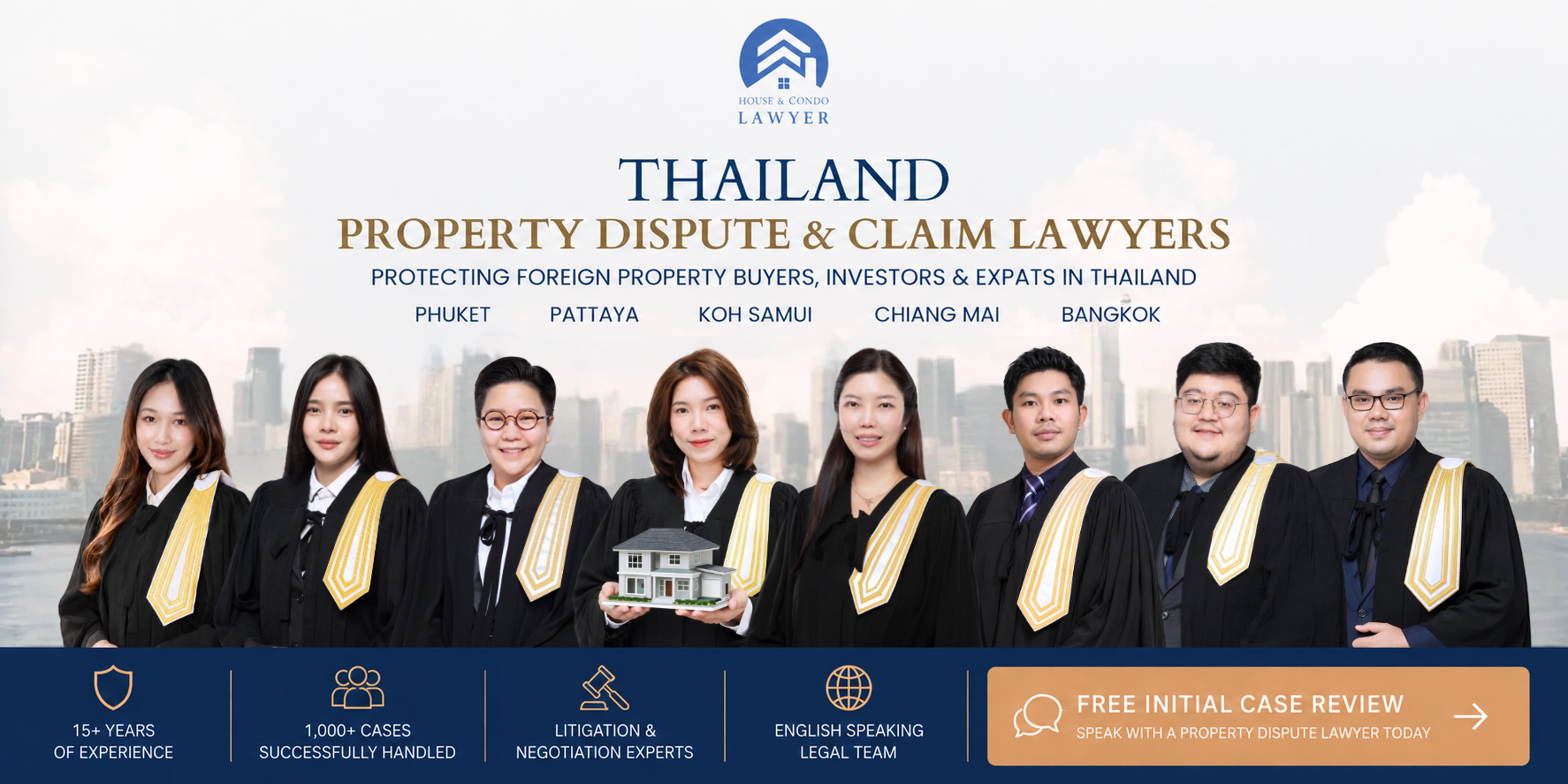
House & Condo Lawyer is a highly experienced Thailand real estate law firm specializing in property disputes, developer claims, and real estate litigation for more than 15 years.
Ranging from property registration cases, off-plan condominium disputes and delayed projects to luxury villa conflicts, construction defect claims, and developer litigation
With extensive courtroom and negotiation experience in Thailand’s property sector, House & Condo Lawyer is widely recognized as one of Thailand’s leading law firms for Property Dispute & Developer Claim cases.
Our legal team assists foreign buyers, expats, overseas investors, retirees, and international property purchasers in disputes against developers, project operators, sellers, and related parties throughout Thailand.
Bangkok • Pattaya • Phuket • Koh Samui • Chiang Mai
FOREIGNERS ALSO PROTECTED BY THAILAND CONSUMER PROTECTION LAWS
Many foreign buyers believe that once they sign a property contract in Thailand, all deposits, down payments, and installment payments are automatically forfeited if a dispute arises.
In reality, this is absolutely not true.
Thailand has consumer protection laws designed to protect individual purchasers and consumers when dealing with large companies, property developers, and real estate projects with substantially greater financial resources and bargaining power. Importantly, foreign buyers may also receive protection under Thai consumer protection laws in many residential property disputes, similar to Thai nationals.
Depending on the facts of the case, foreign buyers may still have legal rights to recover deposits, installment payments, damages, compensation, or investment losses under Thai law.
“YOU MAY STILL HAVE LEGAL RIGHTS UNDER THAI LAW.”
Our litigation team assists foreign buyers and investors in property disputes, developer claims,
and recovery actions throughout Thailand.
HAVE YOU EXPERIENCED ANY OF THESE PROBLEMS?
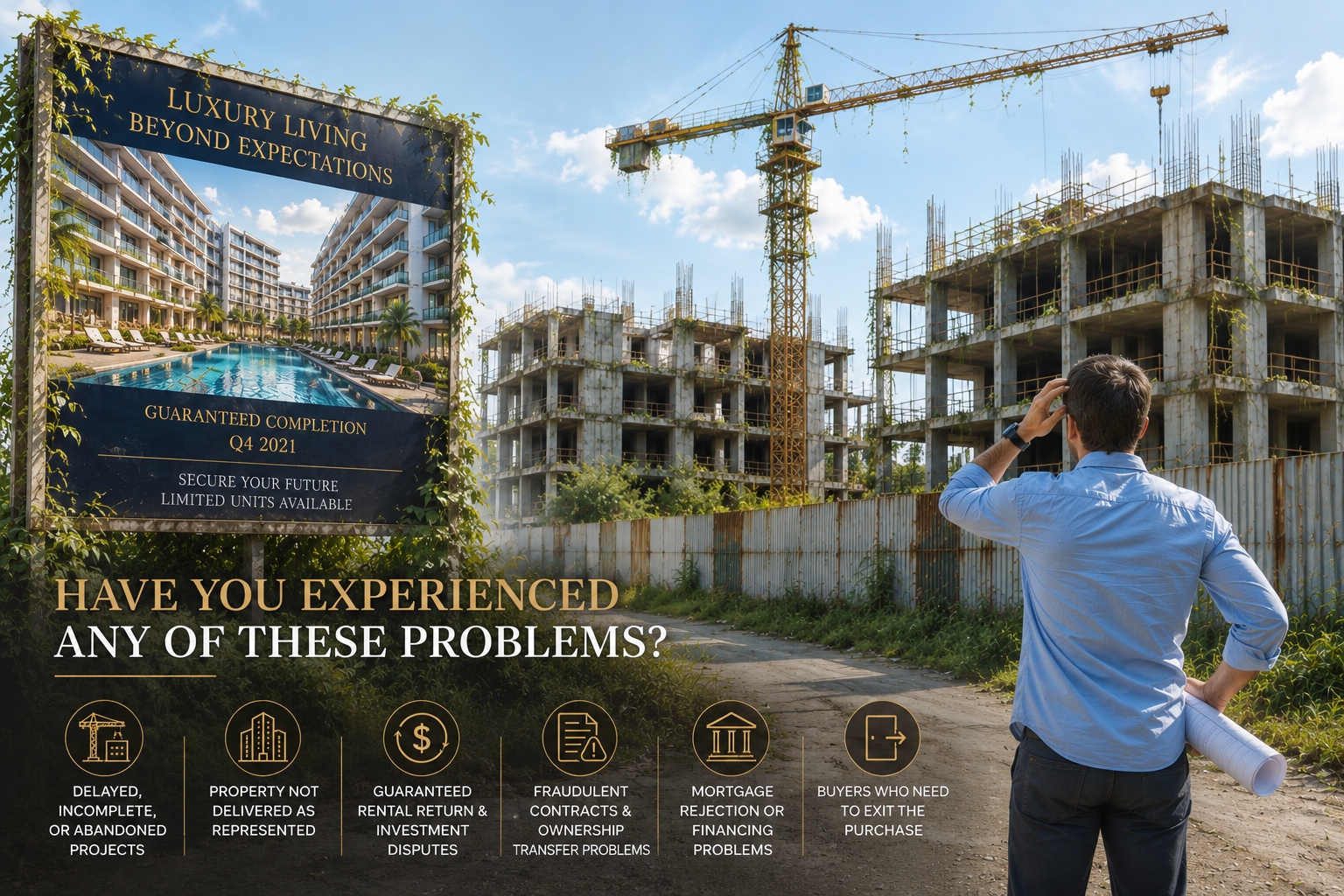
1. Delayed, Incomplete, or Abandoned Projects
Beautiful brochures, luxury promises, guaranteed completion dates — but years later, the project is still unfinished, repeatedly delayed, or completely abandoned. Some sites are left with nothing but empty structures and overgrown grass while buyers continue waiting with no clear answers from the developer.
2. Property Not Delivered as Represented
What was promised during the sales presentation is very different from reality. Facilities disappear, layouts change, construction quality drops, and in some cases the developer simply vanishes, leaving buyers with unfinished projects and damaged investments.
3. Guaranteed Rental Return & Investment Disputes
“Guaranteed returns.”
“Passive income.”
“8%–15% annual returns.”
In many disputes, the promised payments simply never arrive.
The “guaranteed return” was never truly guaranteed at all.
Some developers repeatedly launch project after project, collect money from buyers, use investor funds to build the properties, operate the rental business, collect the rental income themselves, yet never transfer ownership to purchasers or never pay the promised returns.
In more serious situations, buyers later discover massive financial problems, asset transfers, disappearing operators, or thousands of ongoing court cases involving the same developer or related parties.
4. Fraudulent Contracts & Ownership Transfer Problems
Buyers are promised secure ownership and legal transfer structures, only to later discover hidden legal restrictions, incomplete approvals, nominee structures, or contracts heavily drafted in favor of the developer.
5. Mortgage Rejection or Financing Problems
The bank rejects the financing — and suddenly the developer claims that every deposit, down payment, and installment payment is immediately forfeited. Under Thai law, this is not always true.
6. Buyers Who Need to Exit the Purchase
Life changes. Financial problems, relocation, visa issues, divorce, family emergencies, or changing investment circumstances may make it impossible to continue the purchase. Yet many developers still attempt to keep every payment regardless of the actual losses suffered.
Your legal rights may still exist under Thai law — but timing, strategy, and legal action are critically important. Seek proper legal advice as early as possible and protect your rights with an experienced Thailand real estate litigation lawyer.
STANDARD FORM CONTRACTS FOR CONDOMINIUMS
& HOUSING DEVELOPMENT PROJECTS IN THAILAND
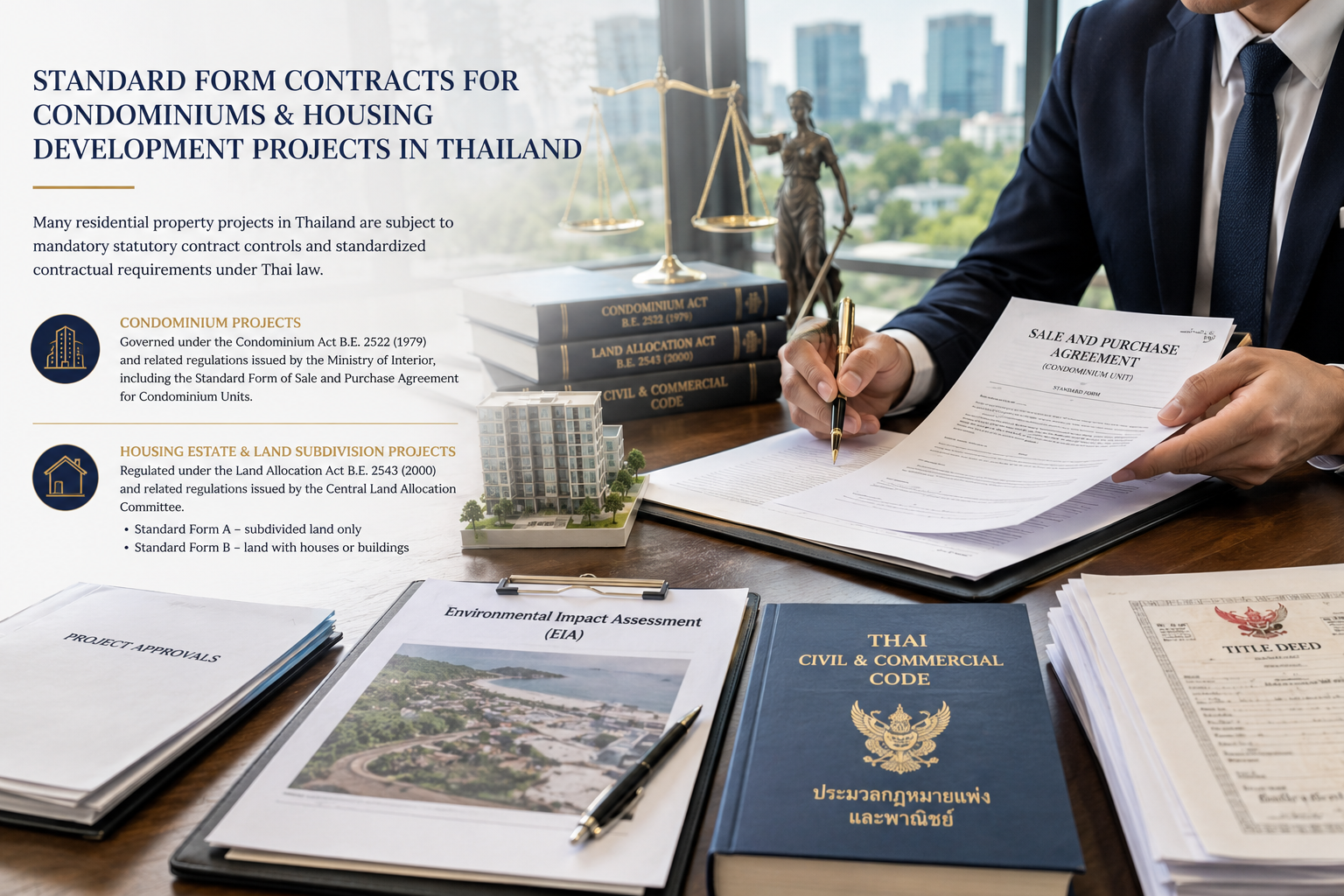
Many foreign buyers incorrectly assume that property developers in Thailand may freely draft any contractual terms they wish. In reality, many residential property projects in Thailand are subject to mandatory statutory contract controls and standardized contractual requirements under Thai law.
For condominium projects, standard sale and purchase agreements are governed under the Condominium Act B.E. 2522 (1979) and related regulations issued by the Ministry of Interior, including the Ministry of Interior Notification Re: Prescribing the Standard Form of Sale and Purchase Agreement for Condominium Units pursuant to the Condominium Act.
For housing estate and land subdivision projects, standard sale and purchase agreements are regulated under the Land Allocation Act B.E. 2543 (2000) and related regulations issued by the Central Land Allocation Committee, including:
- Standard Form A — for land subdivision projects selling subdivided land only
- Standard Form B — for land subdivision projects selling land together with houses or buildings
As a result, developers may not simply insert unfair contractual provisions designed to excessively disadvantage consumers or avoid mandatory legal protections.
Examples of problematic contractual provisions may include:
- Clauses stating that all deposits or down payments are non-refundable in every circumstance
- Clauses allowing indefinite delays in project completion or ownership transfer
- Excessive forfeiture or penalty clauses
- One-sided provisions protecting only the developer
- Clauses allowing material project changes without purchaser consent
- Additional contractual amendments or side agreements attempting to waive mandatory consumer protections
Importantly, contractual provisions more favorable to consumers than the minimum legal protections required by law may remain enforceable. However, contractual clauses, amendments, or additional agreements that conflict with mandatory statutory protections, unfairly disadvantage consumers, or attempt to circumvent mandatory standard contract requirements may be unenforceable, void, or subject to judicial review when disputes are brought before Thai courts
NEW!! Reservation Contracts & Off-Plan Condominium Sales
In 2024, the Contract Committee issued additional contract-control regulations applicable to condominium reservation agreements and booking arrangements under the Notification of the Contract Committee Re: Prescribing the Business of Condominium Unit Reservation as a Contract-Controlled Business B.E. 2567 (2024).
These regulations were introduced partly because some developers — particularly off-plan condominium projects — attempted to avoid mandatory sale and purchase contract protections by accepting reservation payments, booking fees, or deposits without proper contractual documentation.
Under the current regulations, even reservation or booking arrangements may require standardized contractual terms and consumer protections rather than simply accepting purchaser payments without proper agreements.
The regulations also provide important protections allowing consumers to terminate reservation agreements and recover booking payments or deposits in situations including:
- Failure to obtain Environmental Impact Assessment (EIA) approval
- Failure to execute the sale and purchase agreement within the agreed timeframe
- Failure to apply for or obtain construction permits within the contractual period
- Material changes to project layouts, construction plans, specifications, or unit designs without purchaser consent
- Mortgage or financing rejection where the developer was aware that bank financing would be required by the purchaser
Important Considerations for Foreign Buyers Purchasing Villas or Small Non-Registered Housing Projects
Foreign buyers should exercise particular caution when purchasing villas, houses, or small housing developments that are not licensed land subdivision projects under Thai law. The statutory standard contract protections described above may not fully apply.
In Thailand, some developers intentionally structure projects with fewer than 9 subdivided plots in order to avoid obtaining a formal land subdivision license and avoid the legal controls, infrastructure obligations, and standard contract protections applicable to regulated housing estate projects under the Land Allocation Act.
As a result, many statutory protections applicable to licensed housing estate developments may not fully apply to these smaller non-registered projects.
This is especially important for foreign buyers because foreign nationals are generally prohibited from directly owning land in Thailand. In many villa projects, the legal structure may involve lease agreements, nominee arrangements, company structures, or other ownership arrangements that can become significantly more complex in the event of disputes
Foreign buyers should therefore conduct careful legal due diligence before entering into agreements with developers operating outside regulated land subdivision frameworks.
EFFECT OF THAI CONSUMER PROTECTION & STANDARD CONTRACT LAWS
Many residential property transactions in Thailand — particularly condominium developments, housing estate projects, reservation agreements, and off-plan sales — are governed by mandatory statutory controls, standard contract regulations, and consumer protection laws, including the Civil and Commercial Code, the Unfair Contract Terms Act B.E. 2540 (1997), the Condominium Act B.E. 2522 (1979), the Land Allocation Act B.E. 2543 (2000), and related regulations issued by the Ministry of Interior, the Central Land Allocation Committee, and the Contract Committee.
Accordingly, property developers cannot simply draft contractual provisions entirely at their own discretion in order to excessively disadvantage purchasers or circumvent mandatory legal protections.
Under Thai legal principles, the enforceability of contractual provisions may be assessed not only by the wording of the agreement itself, but also by the legal substance, fairness, proportionality, consumer protection considerations, and the practical effect of the contractual terms.
This is particularly important in disputes involving:
- Non-refundable deposit clauses
- Automatic forfeiture provisions
- Excessive penalties or down payment forfeiture
- Delayed project completion or ownership transfer
- One-sided contractual protections disproportionately favoring the developer
- Misleading advertisements, guaranteed return schemes, or investment representations
- Reservation agreements and off-plan project structures
Under Sections 377, 379, and 383 of the Thai Civil and Commercial Code, Thai courts may distinguish between legally forfeitable deposits and installment payments forming part of the purchase price, and may reduce excessive penalties or forfeiture provisions where they are disproportionate to the actual damages suffered.
In addition, Section 4 and Section 7 of the Unfair Contract Terms Act B.E. 2540 (1997) permit Thai courts to examine whether contractual provisions unfairly disadvantage consumers or impose excessive burdens beyond what is reasonable under the circumstances.
Where contractual provisions conflict with mandatory statutory protections, impose disproportionate consequences, or attempt to circumvent applicable standard contract regulations, Thai courts may reduce, limit, disregard, or refuse enforcement of such provisions under applicable law and judicial discretion.
Accordingly, purchasers should not automatically assume that every clause drafted by a developer will necessarily be legally enforceable under Thai law.
10-YEAR Prescription Period / Statute of Limitations Under Thai Law
Many foreign buyers incorrectly assume that they automatically lose all legal rights after several years. In reality, this is not always true. Under Section 193/30 of the Thai Civil and Commercial Code, where no specific prescription period is prescribed by law, claims may be subject to a prescription period of up to 10 years.
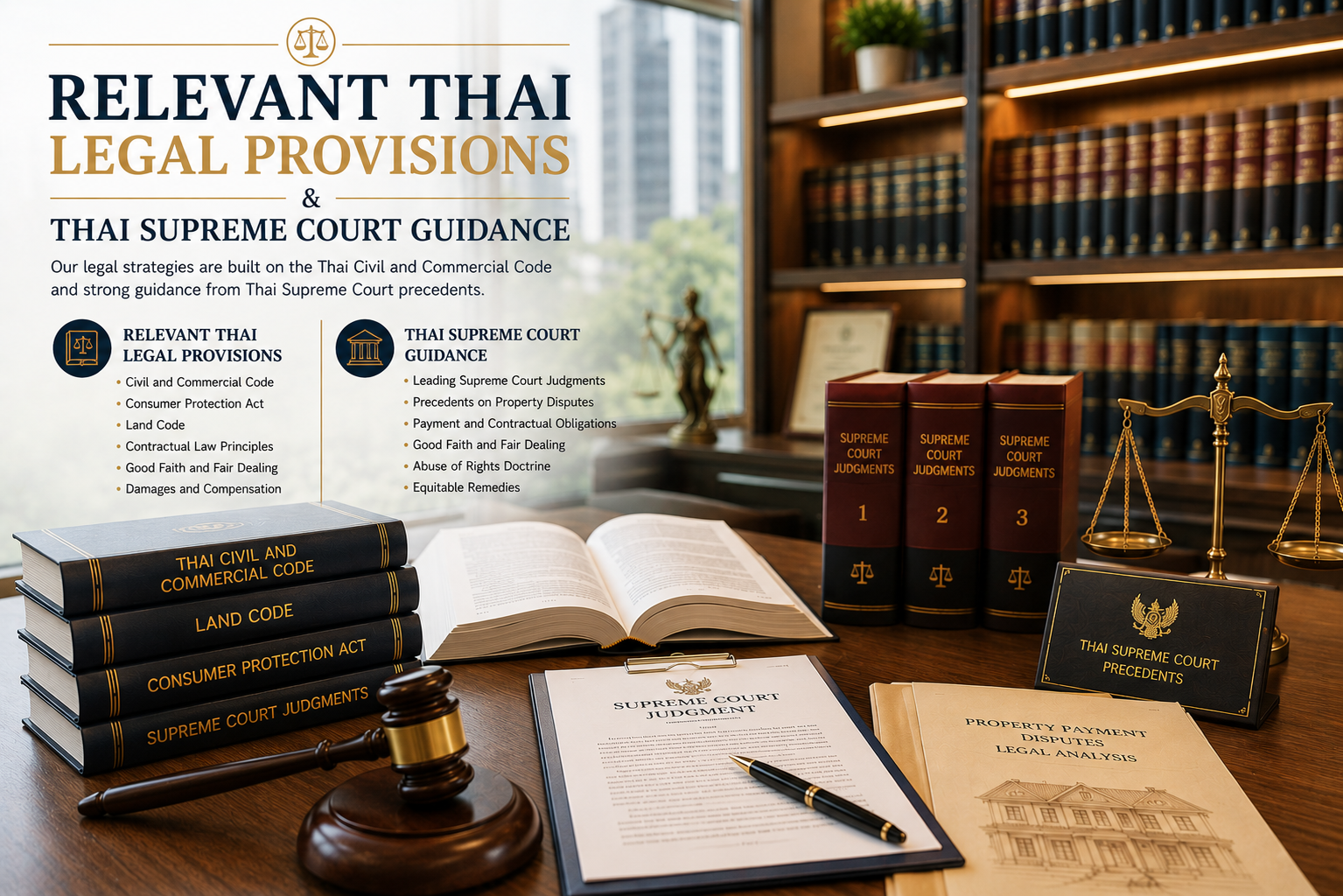
RELEVANT THAI LEGAL PROVISIONS
Civil and Commercial Code Sections 377, 379 & 383
Under Sections 377, 379, and 383 of the Thai Civil and Commercial Code, Thai courts may distinguish between legally forfeitable deposits and installment payments forming part of the purchase price. Contractual forfeiture provisions and penalties may also be subject to judicial review and reduction where the amount is considered excessive or disproportionate to the actual damages suffered.
Civil and Commercial Code Section 193/30 — 10-Year Prescription Period
Section 193/30 of the Thai Civil and Commercial Code provides that where no specific prescription period is prescribed by law, contractual claims may be subject to a general prescription period of up to 10 years.
This principle may apply in certain property refund claims, contractual repayment disputes, and developer-related litigation depending on the legal structure of the claim.
Unfair Contract Terms Act B.E. 2540 (1997)
Sections 4 and 7 of the Unfair Contract Terms Act B.E. 2540 (1997) permit Thai courts to examine whether contractual provisions unfairly disadvantage consumers or impose excessive burdens beyond what is reasonable under the circumstances.
Contractual clauses allowing excessive forfeiture, disproportionate penalties, or unfair one-sided protections may therefore be reduced, disregarded, or deemed unenforceable by Thai courts.
Condominium Act B.E. 2522 (1979)
Condominium sale agreements in Thailand are subject to statutory regulation under the Condominium Act B.E. 2522 (1979), together with related Ministry of Interior regulations prescribing mandatory contractual protections and standardized contractual terms for condominium purchasers.
Land Allocation Act B.E. 2543 (2000)
Housing estate and land subdivision projects in Thailand are regulated under the Land Allocation Act B.E. 2543 (2000) and related regulations issued by the Central Land Allocation Committee.
The law prescribes licensing requirements, infrastructure obligations, and standardized sale and purchase agreement structures for regulated housing developments.
Notification of the Contract Committee Re: Condominium Reservation Agreements B.E. 2567 (2024)
In 2024, the Contract Committee issued regulations classifying condominium reservation and booking arrangements as contract-controlled businesses.
Under these regulations, developers accepting reservation payments, booking fees, or deposits for condominium projects — particularly off-plan developments — may be required to use standardized reservation agreements and comply with mandatory consumer protection obligations.
The regulations also provide important purchaser protections in situations involving:
- Failure to obtain EIA approval
- Failure to obtain construction permits
- Failure to execute sale agreements within the prescribed timeframe
- Material project modifications without purchaser consent
- Mortgage or financing rejection in qualifying circumstances
THAI SUPREME COURT GUIDANCE ON PROPERTY PAYMENT DISPUTES
Thai Supreme Court decisions have repeatedly addressed disputes involving deposits, down payments, installment payments, contractual forfeiture provisions, and consumer protection principles in real estate transactions.
Importantly, Thai courts often examine the true legal nature of the payment and the fairness of the contractual terms rather than relying solely on the wording drafted by the developer.
Thai Supreme Court Judgment No. 3644/2546
Legal Principle: Installment Down Payments Made After Contract Execution Are Not Automatically “Forfeitable Deposits”
The Thai Supreme Court held that installment payments or down payments paid after the contract date may constitute partial purchase price payments rather than legally forfeitable deposits under Section 377 of the Thai Civil and Commercial Code.
The Court further held that contractual provisions allowing forfeiture of all payments may constitute contractual penalties subject to judicial review and reduction.
Thai Supreme Court Judgment No. 7308/2549
Legal Principle: Excessive Forfeiture Clauses May Be Reduced by the Court
The Thai Supreme Court held that contractual forfeiture provisions may constitute penalties under Sections 379 and 383 of the Thai Civil and Commercial Code.
Where the forfeiture amount is excessive compared to the actual damages suffered, Thai courts may reduce the amount to a reasonable level.
Thai Supreme Court Judgment No. 7557/2558
Legal Principle: Mortgage Rejection Cases May Still Result in Refund Rights
The Thai Supreme Court applied Section 7 of the Unfair Contract Terms Act B.E. 2540 (1997) and ordered substantial refunds to purchasers despite the purchasers being unable to obtain bank financing.
The Court held that forfeiture of nearly the entire payment amount constituted an unfair contractual term excessively disadvantaging the consumer.
Thai Supreme Court Judgment No. 5783/2567
Legal Principle: Contractual Refund Claims May Be Subject to a 10-Year Prescription Period
The Thai Supreme Court confirmed that contractual refund claims arising directly from property sale agreements may fall within the general 10-year prescription period under Section 193/30 of the Thai Civil and Commercial Code rather than shorter limitation periods.
PROPERTY FRAUD, DEVELOPER MISREPRESENTATION & PUBLIC FRAUD RISKS IN THAILAND
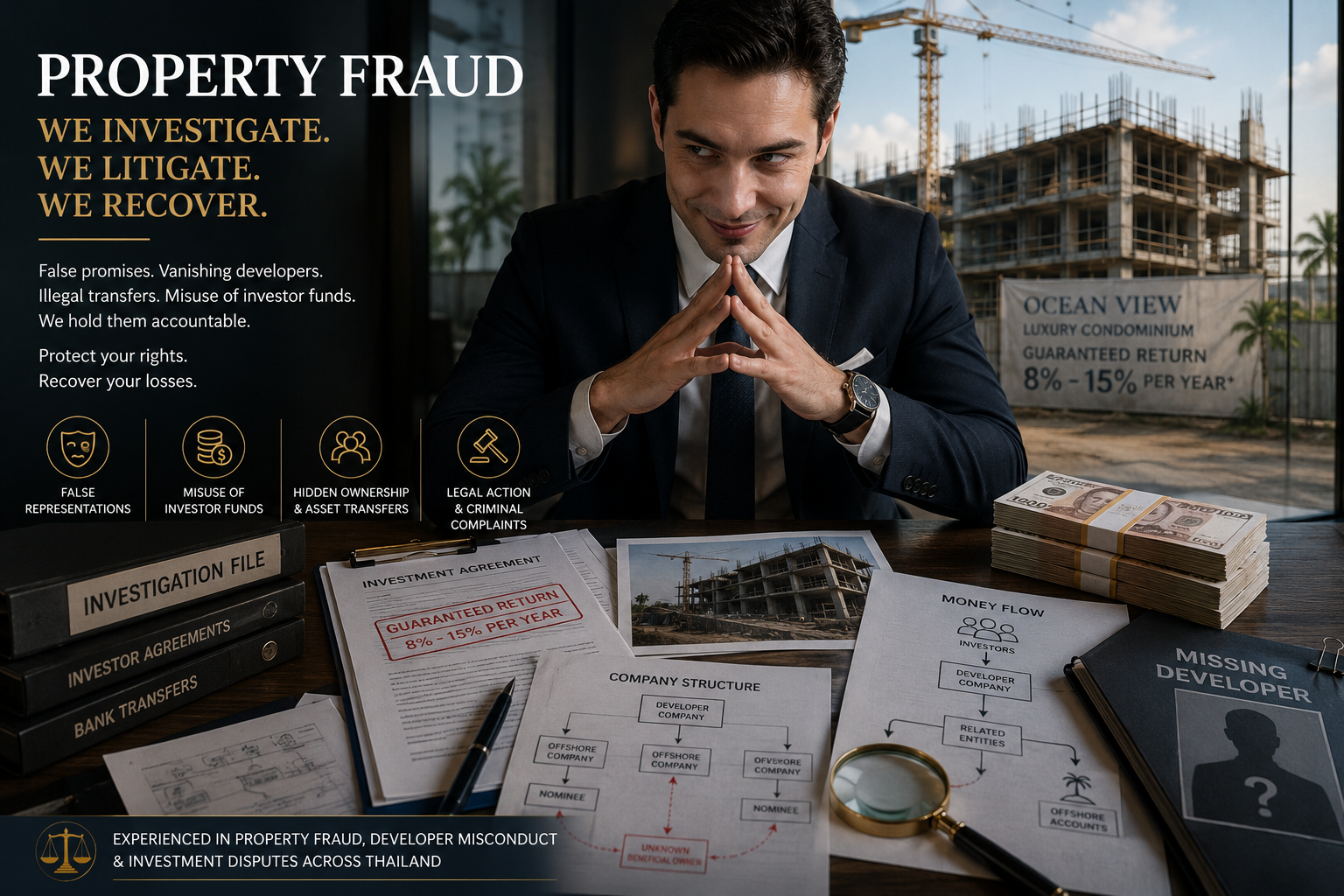
Not every failed property transaction constitutes fraud under Thai law. However, certain disputes may involve fraudulent misrepresentation, false investment promises, concealed legal problems, deceptive guaranteed return schemes, or intentional misconduct designed to induce buyers to invest.
In some large-scale cases, developers may collect money from numerous purchasers, delay or avoid ownership transfers, continue operating rental businesses using investor-funded properties, transfer assets, restructure companies, or leave buyers facing hundreds — or even thousands — of ongoing legal disputes involving the same project or related parties.
Depending on the facts, certain cases may extend beyond ordinary civil disputes and potentially involve fraud or public fraud offences under Sections 341 and 343 of the Thai Criminal Code.
If you believe your case may involve property fraud, developer misrepresentation, investment scams, or large-scale real estate misconduct in Thailand, early legal action and strategic enforcement planning may be critically important.
“By the time many investors realize what happened, the project may already be facing hundreds of disputes, asset transfers, or severe financial problems.”
For more information: Property Fraud Lawsuit in Thailand
Thai Criminal Code Sections 341 & 343 — Fraud & Public Fraud
Sections 341 and 343 of the Thai Criminal Code govern fraud and public fraud offences in Thailand.
In serious real estate disputes involving large-scale misrepresentation, investment fraud, deceptive guaranteed return schemes, or widespread purchaser losses, legal issues may extend beyond civil contractual disputes and potentially involve criminal fraud or public fraud allegations under Thai law.
“WHEN A PROJECT STOPS — YOUR RIGHTS SHOULD NOT”
Whether your case involves delayed construction, abandoned developments, fraudulent investment schemes,
or ownership transfer problems, strategic legal action may still be possible.
IMPORTANT CONSIDERATIONS WHEN CHOOSING
A PROPERTY DISPUTE LAWYER IN THAILAND
Foreign buyers involved in property disputes in Thailand should carefully verify who is actually handling their case.
In certain tourist areas such as Phuket, Pattaya, and Koh Samui, some “legal service providers” may not operate as properly licensed Thai law firms or may rely heavily on unlicensed foreign consultants, rotating litigation lawyers, or non-specialized representatives.
In complex property dispute and developer claim cases, proper legal strategy, conflict-free representation, litigation experience, and professional ethics are critically important.
Buyers should carefully consider:
- Whether the law firm and litigation lawyers are properly licensed in Thailand
- Whether the case is being handled directly by experienced property litigation lawyers
- Whether there may be conflicts of interest involving developers or related parties
- Whether the legal strategy genuinely focuses on recovery and enforcement rather than merely filing proceedings
- Whether the legal team has real experience handling large-scale property disputes and developer litigation
Choosing the right legal team at an early stage may significantly affect the outcome of the case and the ability to recover funds successfully.
WHY FOREIGN BUYERS TRUST HOUSE & CONDO LAWYER
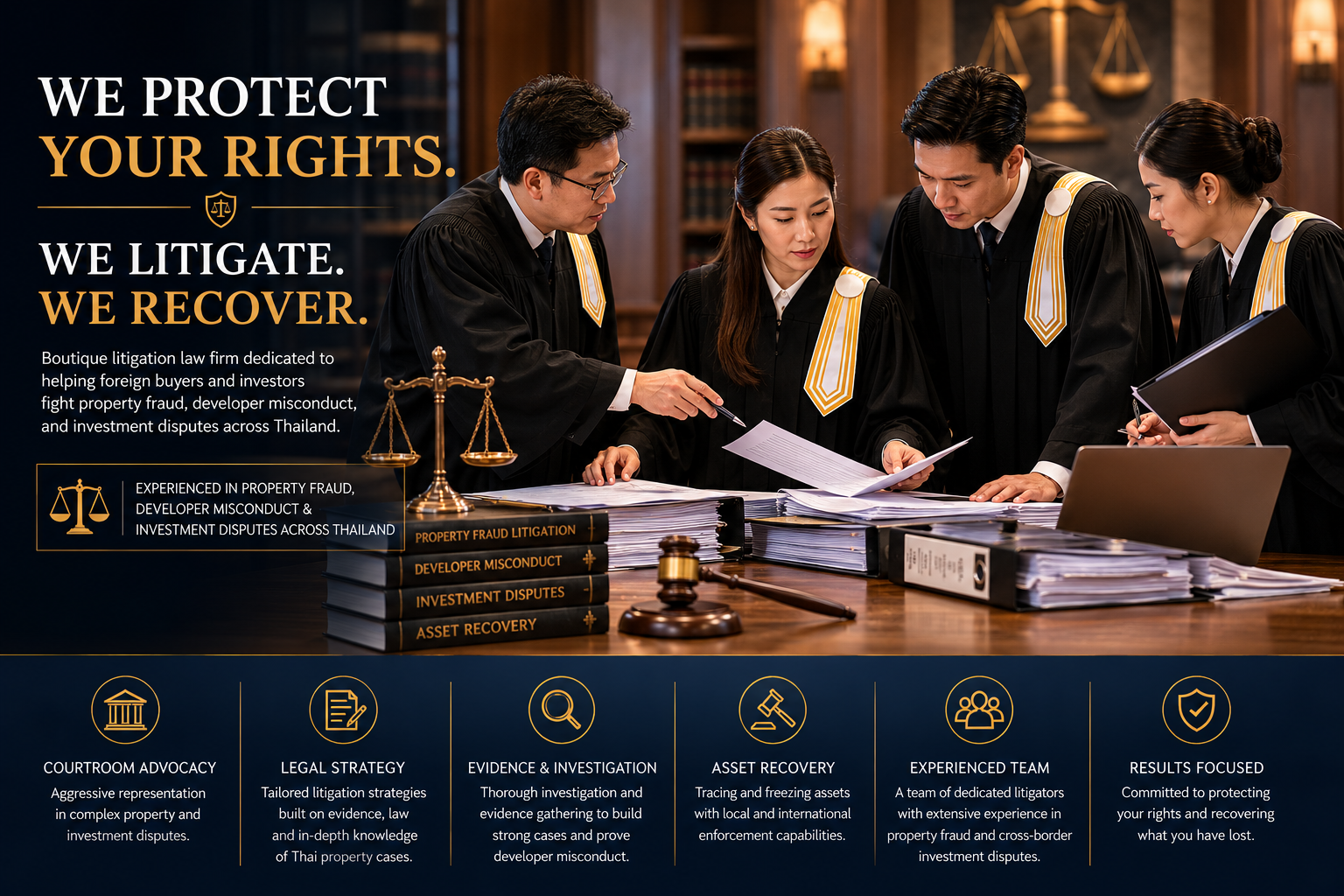
House & Condo Lawyer is a highly experienced Thailand real estate law firm specializing in property disputes, developer claims, and real estate litigation for more than 15 years.
Our legal team has handled over 1,000 real estate and consumer-related dispute cases involving both Thai and foreign clients. We regularly represent clients in more than 300+ cases annually, ranging from property registration cases, off-plan condominium disputes and delayed projects to luxury villa conflicts, construction defect claims, and developer litigation.
With extensive courtroom and negotiation experience in Thailand’s property sector, House & Condo Lawyer is widely recognized as one of Thailand’s leading law firms for Property Dispute & Developer Claim cases.
TRANSPARENT & PRACTICAL FEE STRUCTURE
Property dispute and developer claim cases in Thailand vary significantly depending on the complexity of the project, the developer involved, the legal structure, enforcement risks, and the likelihood of actual recovery.
Thus, legal fees for PROPERTY DISPUTE & DEVELOPER CLAIM matters are commonly structured in stages rather than charged entirely upfront, helping reduce the financial burden on clients. Normally, fees may include an initial litigation stage followed by additional fees after judgment or successful recovery of compensation.
Some projects may involve prolonged litigation, complex corporate structures, ongoing disputes with multiple purchasers, enforcement difficulties, or financial recovery challenges. Certain developers may strongly contest claims through lengthy legal proceedings, while other cases may require strategic enforcement planning beyond obtaining judgment alone.
Because House & Condo Lawyer has extensive experience handling property dispute and developer claim litigation throughout Thailand, our legal team is often familiar with the litigation patterns and practical recovery considerations associated with many major property projects and developers in the market.
We are therefore able to provide practical and appropriate fee structures based on the complexity, risks, and recovery prospects of each case.

“SPEAK WITH A THAILAND PROPERTY DISPUTE & CLAIM LAWYER TODAY”
Delayed projects, failed transfers, and guaranteed return disputes rarely improve with time.
Protect your rights early before recovery becomes more difficult.
House & Condo Lawyer
Property Dispute, Developer Claim & Real Estate Litigation Lawyers in Thailand
Protecting Foreign Buyers, Investors & Expats
Bangkok • Pattaya • Phuket • Koh Samui • Chiang Mai
FREQUENTLY ASKED QUESTIONS (FAQ)
Can foreign buyers sue property developers in Thailand?
Yes. Foreign buyers may pursue legal claims against developers, project operators, sellers, or related parties under Thai law, including claims involving breach of contract, delayed projects, deposit disputes, guaranteed return schemes, construction defects, or fraudulent misrepresentation.
What if my mortgage or bank financing was rejected?
Under Thai legal principles and Supreme Court precedents, installment down payments paid after execution of the agreement are often considered part of the purchase price rather than legally forfeitable deposits.
Where the transaction does not proceed and ownership is never transferred, such installment payments may therefore be refundable in whole or in part depending on the circumstances of the case.
As for reservation fees or deposits, if the forfeiture amount is considered excessive or disproportionate, Thai courts may exercise judicial discretion to reduce the forfeiture amount under applicable Thai law.
(Thai Supreme Court Judgments No. 3644/2546, 7308/2549 and 7557/2558)
Can I file a case if I already left Thailand?
Yes. In many situations, foreign buyers may authorize legal representation through a Power of Attorney and continue the legal process remotely without remaining in Thailand throughout the case.
What if the developer promised guaranteed rental returns but never paid?
Many guaranteed rental return schemes in Thailand fail to operate as originally represented. In numerous disputes, investors later discover that the promised returns were unrealistic, unsustainable, or never genuinely supported by the actual business performance of the project.
In more serious situations involving large numbers of affected investors or substantial financial losses, the legal issues may extend beyond ordinary contractual disputes and potentially involve criminal offences such as public fraud under Sections 341 and 343 of the Thai Criminal Code, which may carry significant criminal penalties under Thai law.
How long do property dispute cases usually take in Thailand?
Many property dispute and developer claim cases in Thailand are filed as consumer cases. In general, the Court will usually schedule the first hearing approximately 2–3 months after the lawsuit is filed.
In many situations, the Court will encourage negotiation or mediation during the first hearing. If the parties cannot reach a settlement, the case will proceed to witness examination and trial. For non-complex cases, a first-instance judgment is often issued within approximately 5–6 months, although the timeframe may vary depending on the complexity of the dispute, the number of parties involved, the developer’s litigation strategy, and enforcement-related
Is there a time limit to file claims against developers in Thailand?
Yes. However, under Section 193/30 of the Thai Civil and Commercial Code, where no specific prescription period is prescribed by law, certain contractual claims may remain enforceable for up to 10 years.
What documents should I prepare for the lawyer?
Useful documents may include:
- Reservation Agreement
- Sale & Purchase Agreement
- Payment Receipts
- Transfer Documents
- Correspondence with the Developer
- Marketing Materials or Advertisements
- Photos, Screenshots, and Evidence relating to the dispute
What happens if the developer already has many lawsuits or financial problems?
This is precisely why strategic litigation planning and enforcement analysis are extremely important.
In some cases, obtaining a judgment alone may not be sufficient. The legal strategy may also involve asset investigations, enforcement planning, coordination with other affected buyers, or additional legal proceedings depending on the circumstances.
If I file a case, how much money can I realistically recover?
This depends primarily on who is legally considered to be in breach of the agreement and the specific facts of the dispute.
If the developer is the party at fault — such as cases involving delayed projects, failure to transfer ownership, construction defects, project abandonment, or contractual violations — buyers may be entitled to recover the full amount paid, including reservation fees, deposits, down payments, installment payments, and potentially interest or additional damages under Thai law.
However, where the buyer is considered the party in breach — such as mortgage rejection, financing failure, or voluntarily withdrawing from the purchase — Thai legal principles and Supreme Court precedents distinguish between installment down payments and legally forfeitable deposits.
Under Thai Supreme Court Judgments No. 3644/2546 and 7308/2549, installment payments made after execution of the agreement are often treated as part of the purchase price rather than automatically forfeitable deposits. Where ownership is never transferred, such payments may therefore be refundable in whole or in substantial part depending on the circumstances.
As for reservation fees or deposits, developers may have rights to retain part of such amounts. However, if the forfeiture amount is excessive or disproportionate to the actual damages suffered, Thai courts may reduce the amount under Sections 379 and 383 of the Thai Civil and Commercial Code and applicable Supreme Court precedents.
In many consumer cases, Thai courts will also encourage negotiation or mediation before proceeding fully through trial, and settlement decisions ultimately remain subject to the client’s instructions and objectives.
What should I do if the developer sends a project delay notice or postponement letter?
Under Thai standard form property contracts, developers are generally required to specify the reasons for the delay and, in many situations, must demonstrate that the delay was caused by legitimate force majeure events or circumstances beyond their control within the prescribed contractual or legal timeframe.
If you do not agree with the delay reasons or do not wish to accept the postponement, it is extremely important to formally respond and reserve your legal rights rather than remaining silent.
In certain cases, Thai courts may interpret prolonged silence or failure to object as acceptance of the delay or waiver of certain objections relating to the postponed completion or transfer schedule.
For this reason, buyers should consider responding formally and preserving evidence if they intend to dispute the delay, reject the extension request, claim damages, or preserve future legal remedies against the developer.
CONTACT OUR PROPERTY DISPUTE LAWYER TEAM
MEET OUR LEAD COUNSEL

Lawyer Montira is a highly experienced and respected Thai attorney specializing in corporate governance, compliance, and fraud litigation involving foreign clients in Thailand. With over a decade of legal practice across a range of industries — including real estate, investment, and international business — she is known for her ability to deliver clear, strategic legal advice and handle high-stakes contractual matters with precision.
She has successfully advised numerous companies and investors on regulatory compliance, particularly with the Securities and Exchange Commission (SEC) and the Stock Exchange of Thailand (SET), helping clients navigate legal risks and maintain credibility in the Thai business landscape.
Education & Qualifications
- Master of Laws (LL.M. in International Trade Law) University of Essex, UK
- Bachelor of Laws (LL.B.) Faculty of Law, Thammasat University, Bangkok
- Attorney License (Thailand)
- Notarial Services Attorney License
Areas of Legal Practice and Specialization
- Criminal Offence Procedure from law enforcement level to court’s litigation
- Legal and Government Affairs
- Business Disputes Resolutions
- Listed company secretarial filing
- Real-Estate and Property lawsuits and transaction
Experiences – Head of Legal & Corporate Lawyer & Consultant
- KPN Groups
- Raimon Land Public Company Limited
- TOA Paint (Thailand) Public Company Limited
- Siam Makro Public Company Limited
- Pace Development Corporation Public Company Limited
- Ananda Development Public Company Limited
- PAE (Thailand) Public Company Limited

Lawyer Vivian brings over 15 years of hands-on experience in Thailand’s real estate and property agency sector, making her one of the most trusted legal advisors in this field. She has consistently provided professional legal consultation and representation to both domestic and international clients, with a particular focus on real estate transactions, land ownership, leasehold agreements, and development advisory across Thailand.
With her deep knowledge of Thai property laws and strong background in the practical aspects of the real estate business, Lawyer Vivian bridges the gap between legal requirements and real-world investment — ensuring her clients make well-informed, legally secure decisions.
Education & Qualifications
- LLB. Laws, Chulalongkorn University (Honor)
- M.P.P. Public Policy, University of Sydney, Australia
- B.A. Political Science, Chulalongkorn University (Honor)
- Certificate Secondary School, Belmont, MS.USA
- Certificate RE-CU, Interior Faculty, Chulalongkorn #27
- Attorney License (Thailand)
Areas of Legal Practice and Specialization
- Legal Consultation on real estate and property laws.
- Real Estate Business Contracting Specialist.
- Attorney-at-laws, on trustee and estate settlement.
- Property Transaction and Negotiation.
- Notarial Service Lawyer
- Foreigner Affair & Family Legal Service
- Thailand Visa & Immigration
Experiences
- Foreign Security committee to lead consultant of Deputy Prime Minister.
- Head of Business for corporate Real Estate /Property Agency .
- Property Consultation Australia and Thailand.
- Business Consultation for healthcare business groups.
OUR THAILAND OFFICES
BANGKOK OFFICE

House & Condo Lawyer (Bangkok)
Unit L2-A9, building A (2nd Floor)
Nasa Street Mall (Airport Link Ramkhamhaeng )
No.99 Ramkhamhaeng Rd., Khwaeng Suan Luang,
Suan Luan Bangkok, Thailand 10250
Tel: 080-315-5686
PHUKET OFFICE
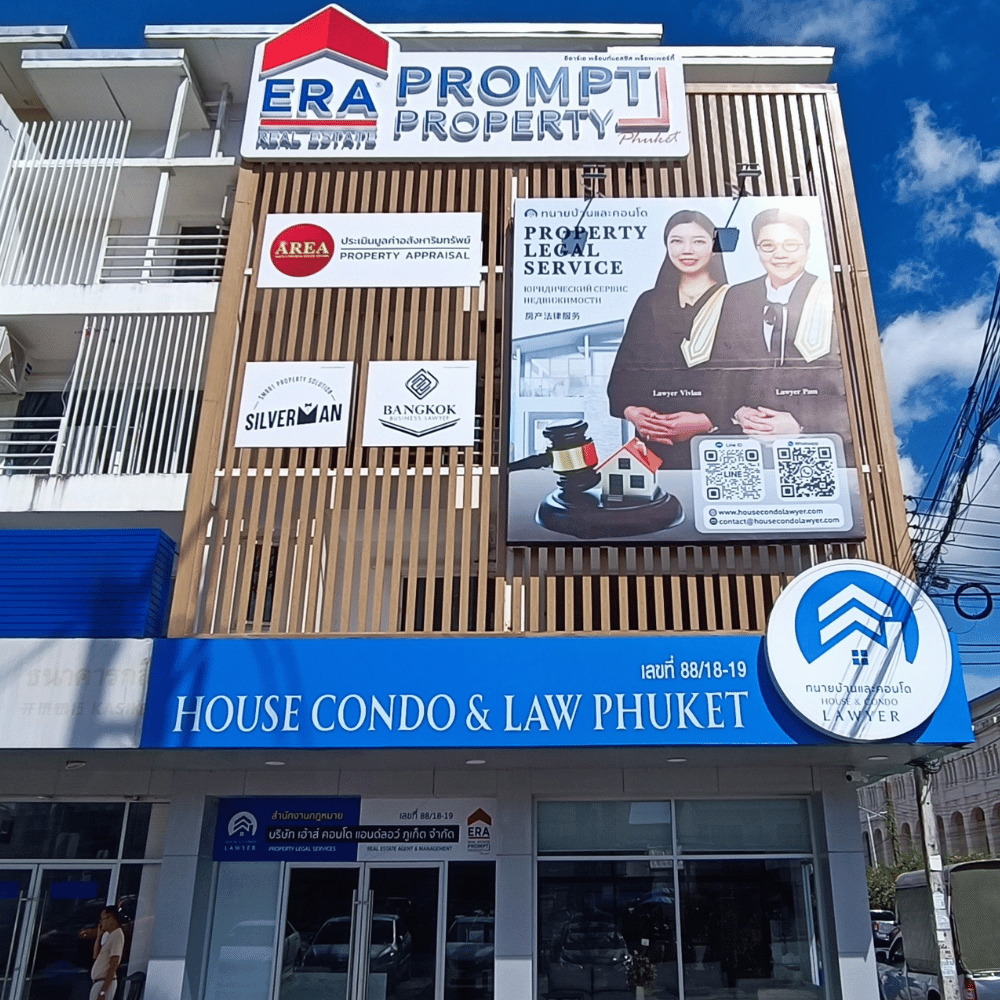
House & Condo Lawyer (Phuket)
88/18 Moo 3 Srisoonthorn Sub district,
Thalang District, Phuket Province 83110
Tel: 098-824-3555 (Phuket & International)
Our Other Services