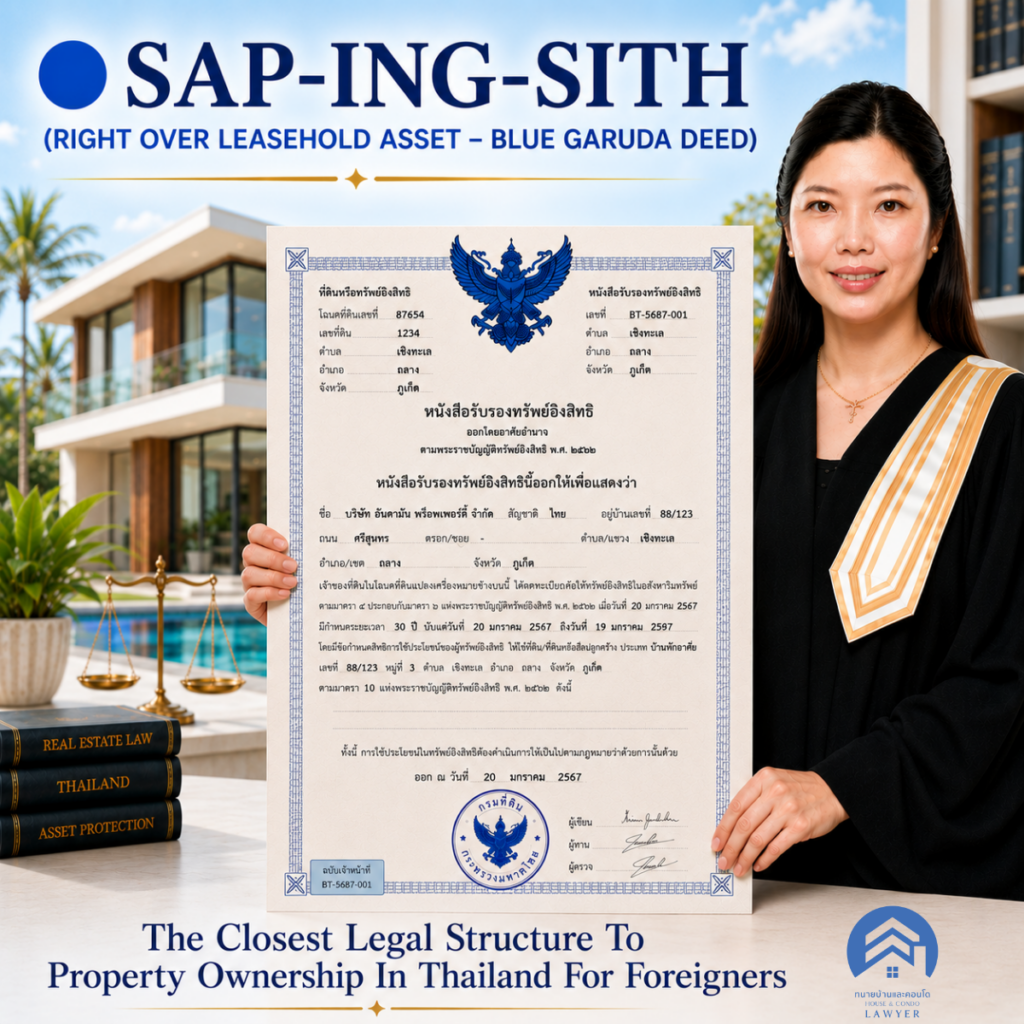

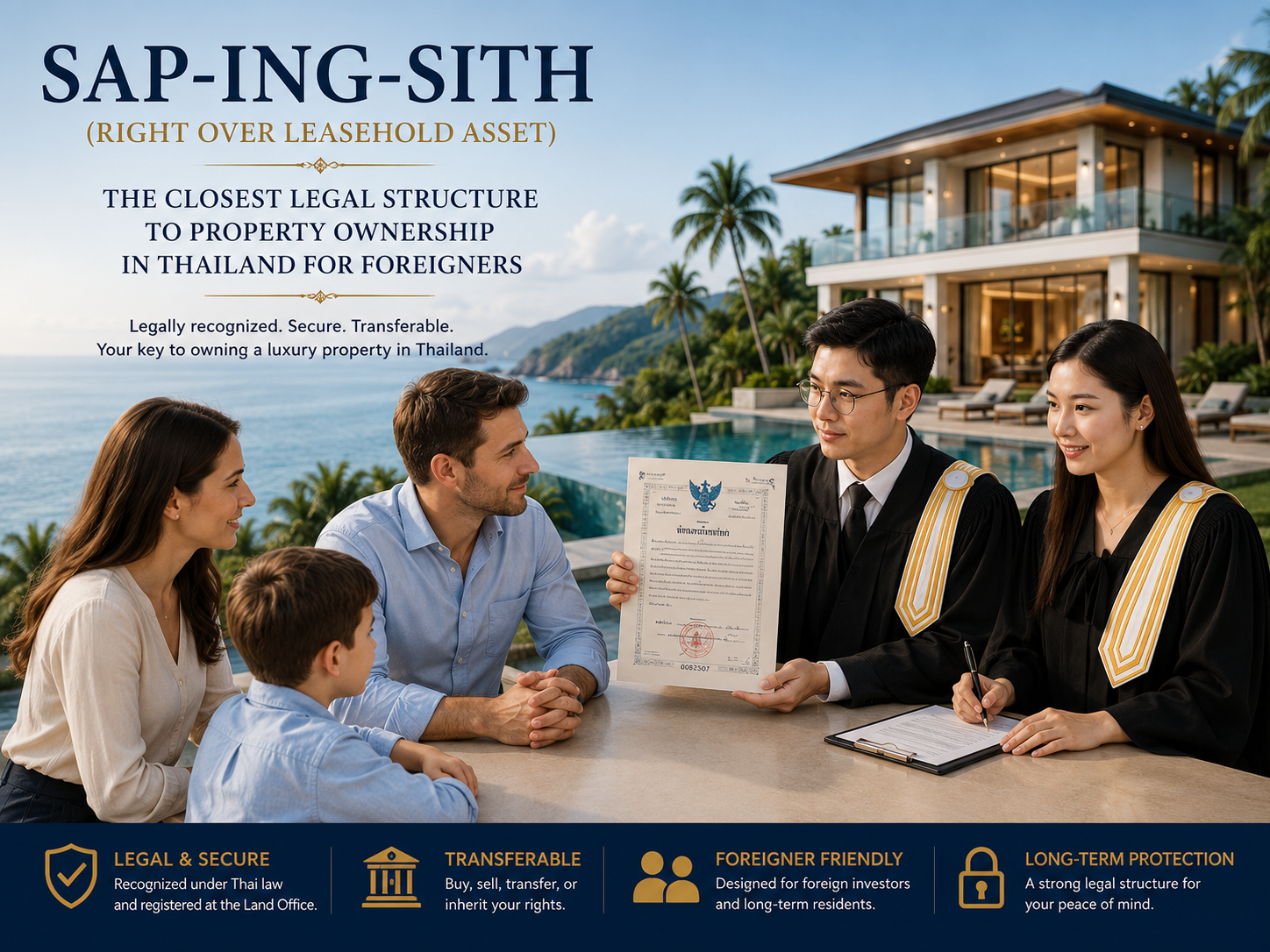
SAP-ING-SITH (RIGHT OVER LEASEHOLD ASSET – BLUE GARUDA DEED ทรัพย์อิงสิทธิ) | NOMINEE CRACKDOWN SOLUTIONs |THAILAND PROPERTY LEGAL SERVICE
Establish • Register • Transferable • Inheritable • Right Structuring • Tax Planning • Legitimate Property Holding Company • NO NOMINEE STRUCTURE !!
Secure Your Villa, House & Property Investment in Thailand — Legally, Professionally & Tax-Efficiently – Bangkok • Pattaya • Phuket • Koh Samui • Chiang Mai
Structured by Specialized Thailand Property Lawyers with Experience in 100+ Sap-Ing-Sith Cases



House & Condo Lawyer
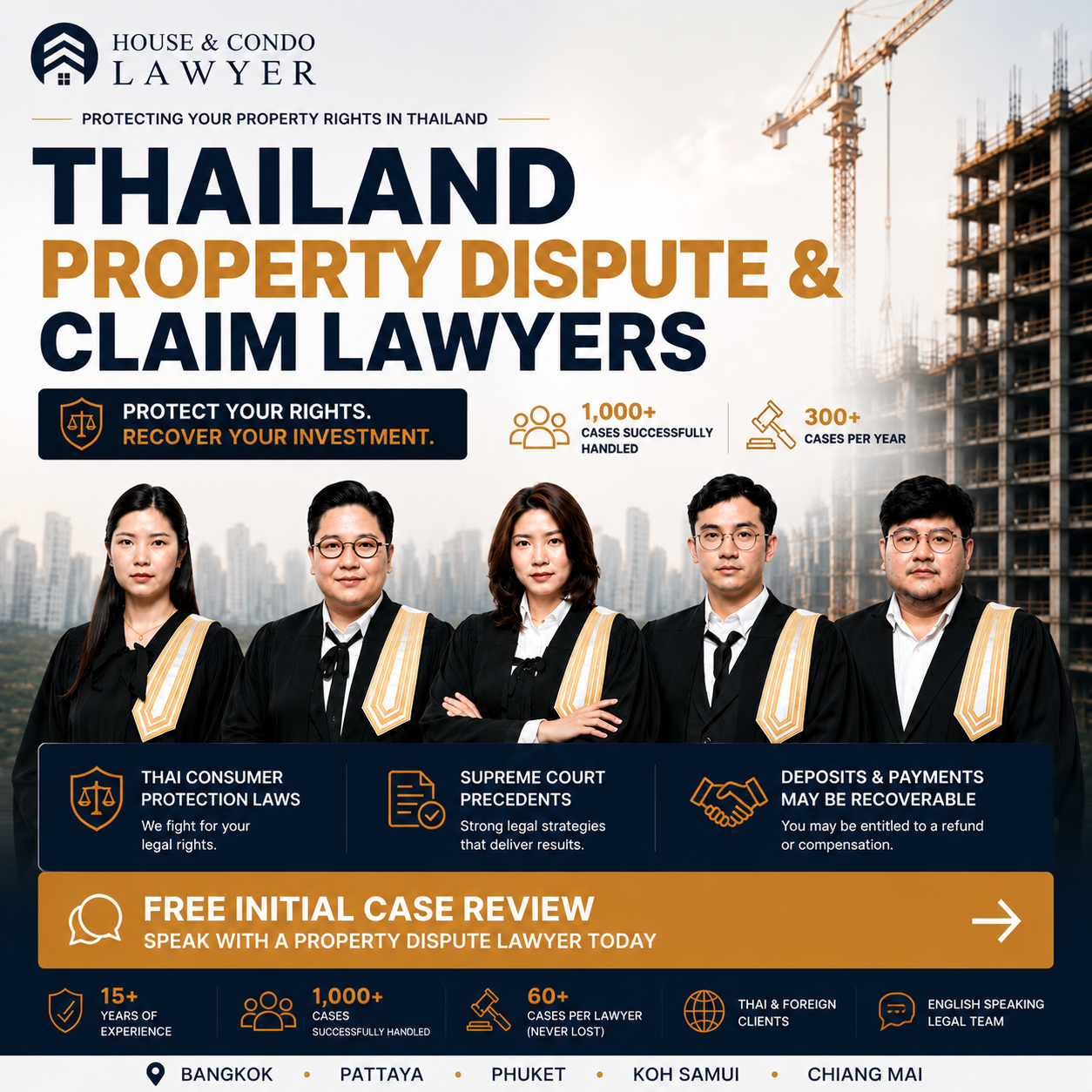
House & Condo Lawyer is a specialized Thailand real estate law firm with more than 15 years of experience in real estate law, foreign property investment and complex property structures in Thailand.
Our legal team has handled more than 1,000 real estate cases involving both Thai and international clients, with more than 300+ property-related cases annually, including luxury villas, foreign investment structures, developer disputes and long-term property holding arrangements throughout Thailand.
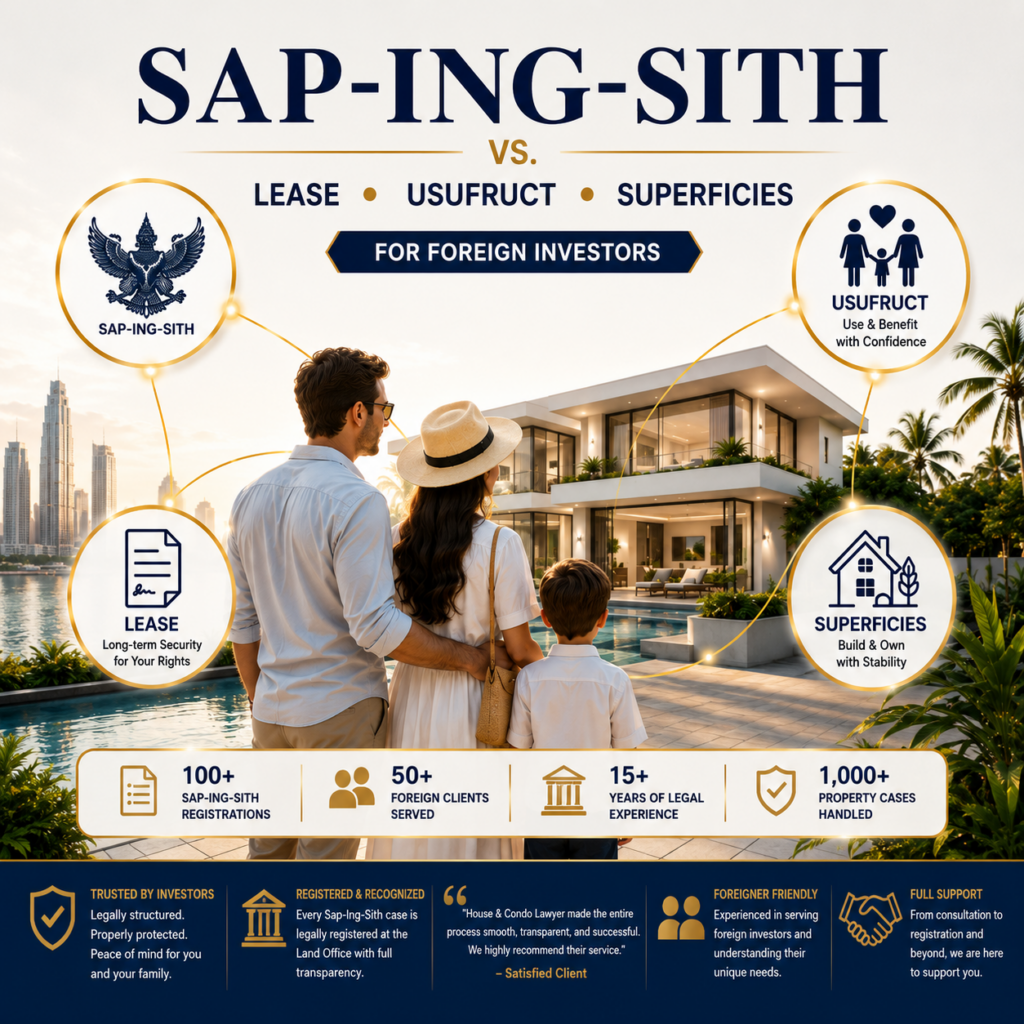
We also have practical experience in structuring and registering more than 100+ Sap-Ing-Sith (Rights Over Leasehold Asset) structures in compliance with Thai law.
15+ Years Real Estate Experience
1,000+ Property Cases
300+ Cases Annually
100+ Sap-Ing-Sith Structures
Our Legal Services Include
- Sap-Ing-Sith Registration, Establishment & Legal Structuring
- Due Diligence Review for Sale & Purchase Agreements and Sap-Ing-Sith Establishment Agreements
- Foreigner’s Villa & Property Investment in Thailand
- Consultant to Real Estate Agency & Developer
- Legitimate Holding Company | Contract & Agreements
- NOMINEE & Holding Structure Legal Review
- Asset Protection & Succession Planning
- Building Ownership & Construction Rights Structuring
- Contract Drafting & Registration Coordination
- Legal Review of Existing Leasehold & Property Holding Structures
- Prenuptial Agreement for lawful Thai spouse
Speak with a Specialized Thailand Property Lawyer Today
Get professional legal guidance on Sap-Ing-Sith, Long-Term Lease, Property Structuring, and Foreign Ownership Solutions.
No Obligation. No Consultation Fee for Your First Discussion.
WHY MANY FOREIGN PROPERTY INVESTORS ENCOUNTER PROBLEMS IN THAILAND?
For many foreign investors, buying property in Thailand is often the easy part.
The real challenges usually appear years later.
Many investors focus on the property itself — the villa, condominium, land, or development project. However, few take the time to carefully consider the legal structure behind the investment.
Unfortunately, some of the most serious property disputes in Thailand do not arise because of the property.
They arise because of the ownership structure chosen at the beginning
Questions such as:
- Who legally controls the land?
- What happens if relationships change?
- Can the investment be transferred or inherited?
- Will the structure still work 10, 20, or 30 years from now?
- What happens if government policies become stricter?
These are issues that many investors only begin to consider after problems arise.
Common concerns include nominee investigations, ownership disputes, inheritance complications, transfer restrictions, tax exposure, and long-term dependence on third parties.
THE PROPERTY MAY BE VALUABLE.
BUT THE STRUCTURE HOLDING IT MATTERS EVEN MORE.
A well-designed legal structure can provide greater certainty, flexibility, inheritance planning, and long-term investment security.
That is one of the reasons why many foreign investors explore alternative legal structures such as SAP-ING-SITH (Right Over Leasehold Asset) when investing in Thailand.
Not Sure Whether Your Current Structure Is Safe?
Our lawyers can review your existing ownership structure and identify potential legal risks.
No Obligation. No Consultation Fee for Your First Discussion.
WHAT IS SAP-ING-SITH? (RIGHT OVER LEASEHOLD ASSET)
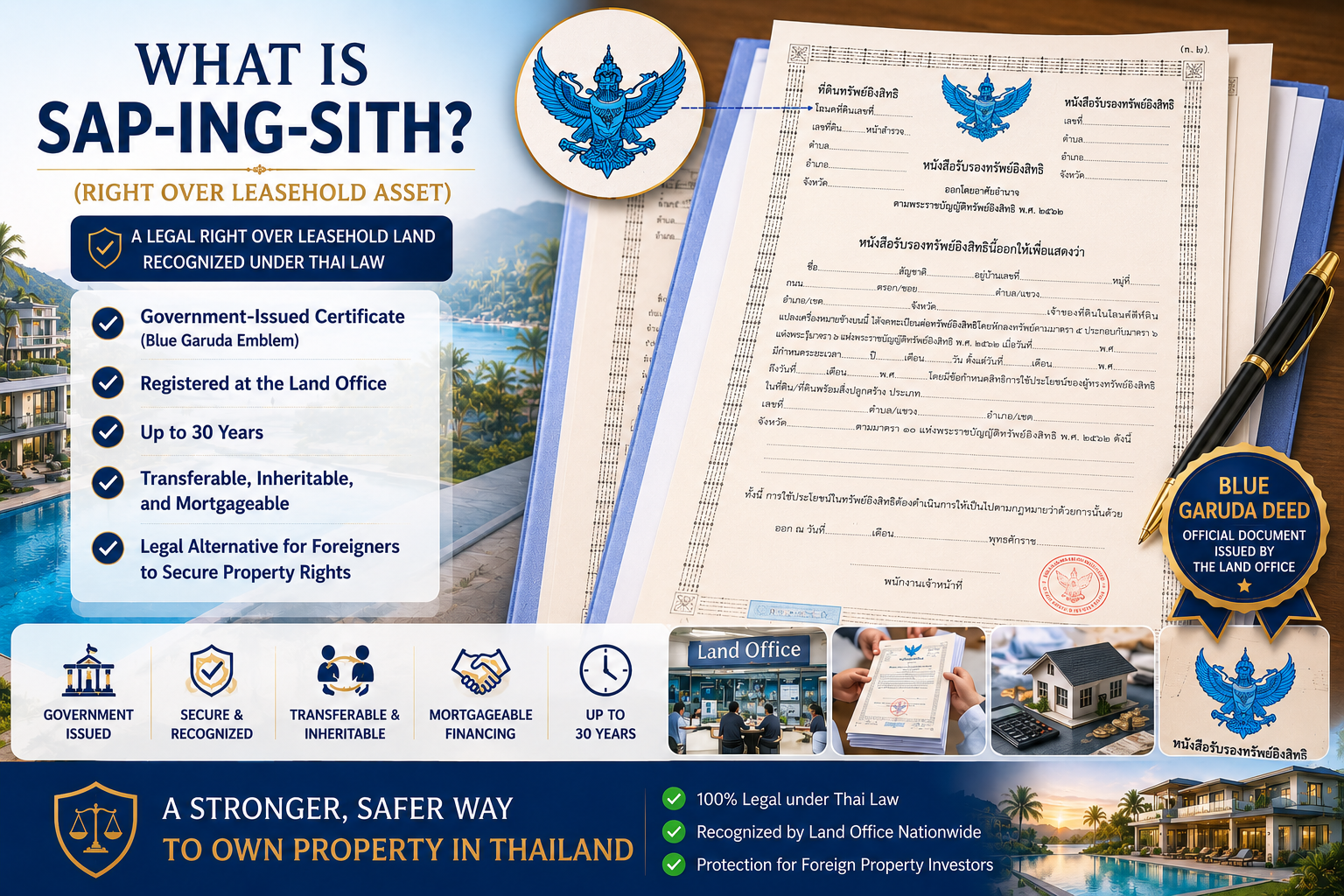
For many foreign investors, one of the biggest concerns when investing in Thailand is not simply whether they can purchase the property — but whether the ownership structure itself will remain legally secure in the future.
Over the years, many investors relied upon leasehold arrangements, nominee structures or holding companies without fully understanding the long-term legal and tax implications involved. In practice, some structures later created problems involving inheritance rights, transferability, retroactive tax exposure, ownership disputes, forced asset sales or regulatory scrutiny.
Sap-Ing-Sith (Rights Over Leasehold Asset), often referred to in the market as the “Blue Garuda Deed,” was introduced under Thai law, RIGHTS OVER LEASEHOLD ASSET ACT B.E. 2562 announced on April 2019, as a legally recognized and registrable “PROPERTY RIGHT” intended to support long-term foreign real estate investment while reducing reliance on nominee arrangements and legally questionable ownership structures.
Upon establishing the RIGHT OVER (LEASEHOLD) ASSET, “the certificate of rights over leasehold asset (Blue Garuda Deed) will be issued. Its function is almost equal to the title deed (RED Garuda Deed) or strata title (the document of condo ownership—”Aor”Chor 2” in Thai) as the case may be. The Sap-Ing-Sith holder has right, duty, and liability in the immovable property which it has been established as if he/she is the owner of immovable property, except right to track and get immovable property back from a person who has no right to hold onto and right to obstruct another person not to interfere illegally with such immovable property. (Section 11)
Although it is not direct ownership of land, Sap-Ing-Sith provides foreigners with a formally registered right over immovable property under a dedicated statutory framework together with significantly greater legal structure, transferability and long-term investment certainty than traditional long-term lease registration.
Key Advantages of Sap-Ing-Sith (Blue Garuda Deed)
- Separate government-issued certificate (Blue Garuda Deed) for foreign investors
- Rights and practical usage capability similar to title ownership in many aspects
- Ability to apply for construction permits and deal directly with government authorities
- Greater independence from the underlying land owner during the registration period
- Transferable and capable of being mortgaged or used as collateral (Section 12)
- Inheritable and suitable for long-term succession planning
- Greater legal certainty and structural clarity than traditional long-term lease arrangements
For foreign investors seeking to secure villas, retirement residences and long-term property investments in Thailand legally, professionally and tax-efficiently, Sap-Ing-Sith has become one of the most important legal alternatives available under Thai law today.
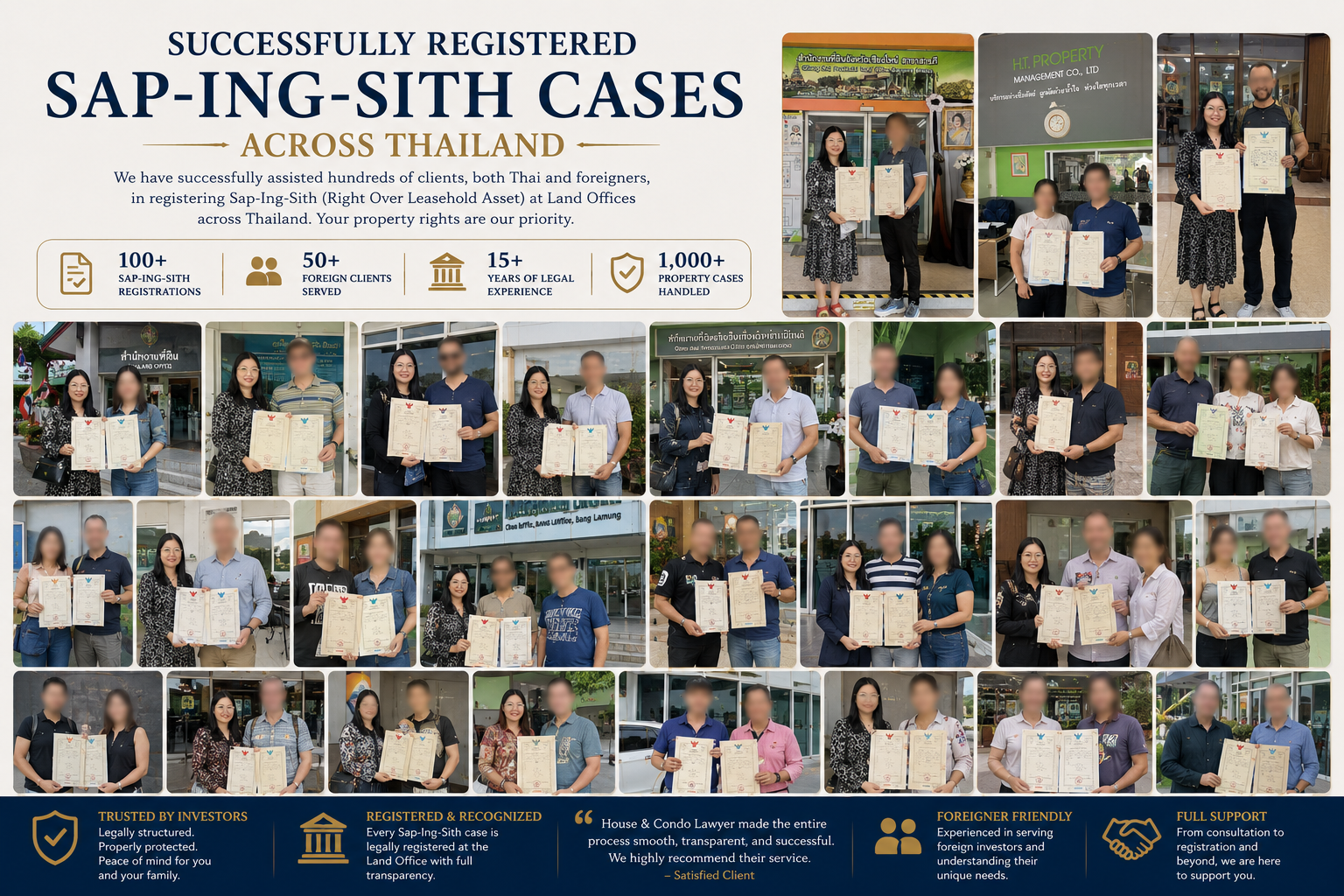
HOUSE & CONDO LAWYER, We have successfully structured, established, and registered more than 100+ Sap-Ing-Sith structures across Thailand for both Thai and foreign clients. Our work goes far beyond simply registering a legal right at the Land Office. We advise on the entire structure — including legal possession, rights allocation, contract duration, tax planning, ownership structuring, and long-term risk management.
We are among the few law firms in Thailand with extensive practical experience in Sap-Ing-Sith structuring and registration, including successful registrations in highly scrutinized jurisdictions known for strict review standards.
The Origin & Legal Background of Sap-Ing-Sith
Sap-Ing-Sith (Rights Over Leasehold Asset) is a unique legal concept created specifically under Thai law and exists only in Thailand. It represents one of the few occasions in which Thai legislation was intentionally designed to support long-term foreign investment in Thai real estate through a legally recognized and registrable property right.
The legislation emerged from Thailand’s broader policy objective of promoting foreign investment in the real estate sector. Over the years, lawmakers and policymakers recognized that many legal rights previously used by foreign investors — including traditional leasehold arrangements, usufruct rights and various holding structures — were not originally designed for long-term foreign property ownership or residential investment purposes
As a result, Sap-Ing-Sith was introduced as a dedicated legal framework intended to allow foreigners to hold legally recognized “rights” over Thai real estate in a more transparent and regulated manner, while also reducing reliance on nominee arrangements and legally questionable ownership structures.
Originally, early legislative discussions contemplated granting Sap-Ing-Sith rights for a significantly longer duration than the conventional 30-year leasehold framework, potentially extending to approximately 60 years in order to better support long-term foreign investment. However, due to legislative and policy considerations, the final enacted structure ultimately adopted a registration period more closely aligned with the traditional 30-year framework. (Section 4)
Nevertheless, the underlying legislative structure and policy direction of Sap-Ing-Sith were originally designed with the possibility of substantially longer durations in mind — potentially extending to 60 or even 90 years if supported by future government policy and legislative reform.
From a legislative perspective, expanding the duration of Sap-Ing-Sith rights in the future may also be more practical than attempting to amend the broader leasehold framework under Section 540 of the Civil and Commercial Code together with related Land Department regulations and administrative provisions governing traditional leasehold registration.
For this reason, many legal practitioners and real estate professionals continue to view Sap-Ing-Sith as a legal framework with significant long-term policy potential for future foreign real estate investment structures in Thailand.
Because Sap-Ing-Sith remains relatively new within the Thai legal system, registration procedures and administrative practices may still vary among Land Offices in different jurisdictions throughout Thailand. For this reason, professional legal coordination and practical experience remain important when structuring and registering Sap-Ing-Sith rights.
Although Sap-Ing-Sith is still a relatively new legal structure, as of the date of this publication, we are not aware of any Supreme Court, Appeal Court, or lower court judgments directly involving disputes over Sap-Ing-Sith rights, including transfer disputes, inheritance disputes, termination disputes, or other major property litigation. This reflects not a weakness of the structure, but rather the fact that Sap-Ing-Sith remains a relatively new legal mechanism under Thai law.
In practice, the more immediate legal risks today often arise not from disputes over Sap-Ing-Sith rights themselves, but from issues involving tax compliance, nominee arrangements, beneficial ownership, and regulatory enforcement. Similar issues have long existed in traditional long-term lease structures, particularly where the registered landowner fails to properly declare lease income or related tax obligations, later resulting in retroactive tax assessments, penalties, and surcharges —especially in the current regulatory environment as tax enforcement and anti-nominee scrutiny continue to intensify.
Importantly, Sap-Ing-Sith derives its legal authority from the **Sap-Ing-Sith Act B.E. 2562 (2019)** — a dedicated Act of Parliament specifically enacted for this legal right. This distinguishes Sap-Ing-Sith from other legal structure rights governed primarily under the Thai Civil and Commercial Code, such as long-term lease registration under **Section 540 CCC**, **The Right of Superficies (Sections 1410–1416 CCC)**, and **The Right of Usufruct (Sections 1417–1428 CCC)**.
For this reason, Sap-Ing-Sith is widely regarded as one of the most sophisticated, secure, and legally robust property rights currently available in Thailand for foreign-related property investment planning. As a legal right governed under a dedicated Act rather than merely individual provisions of the Civil and Commercial Code, Sap-Ing-Sith offers a higher level of legal certainty, security, enforceability, and long-term protection when properly structured and registered.
Types of Property Eligible for Sap-Ing-Sith Registration
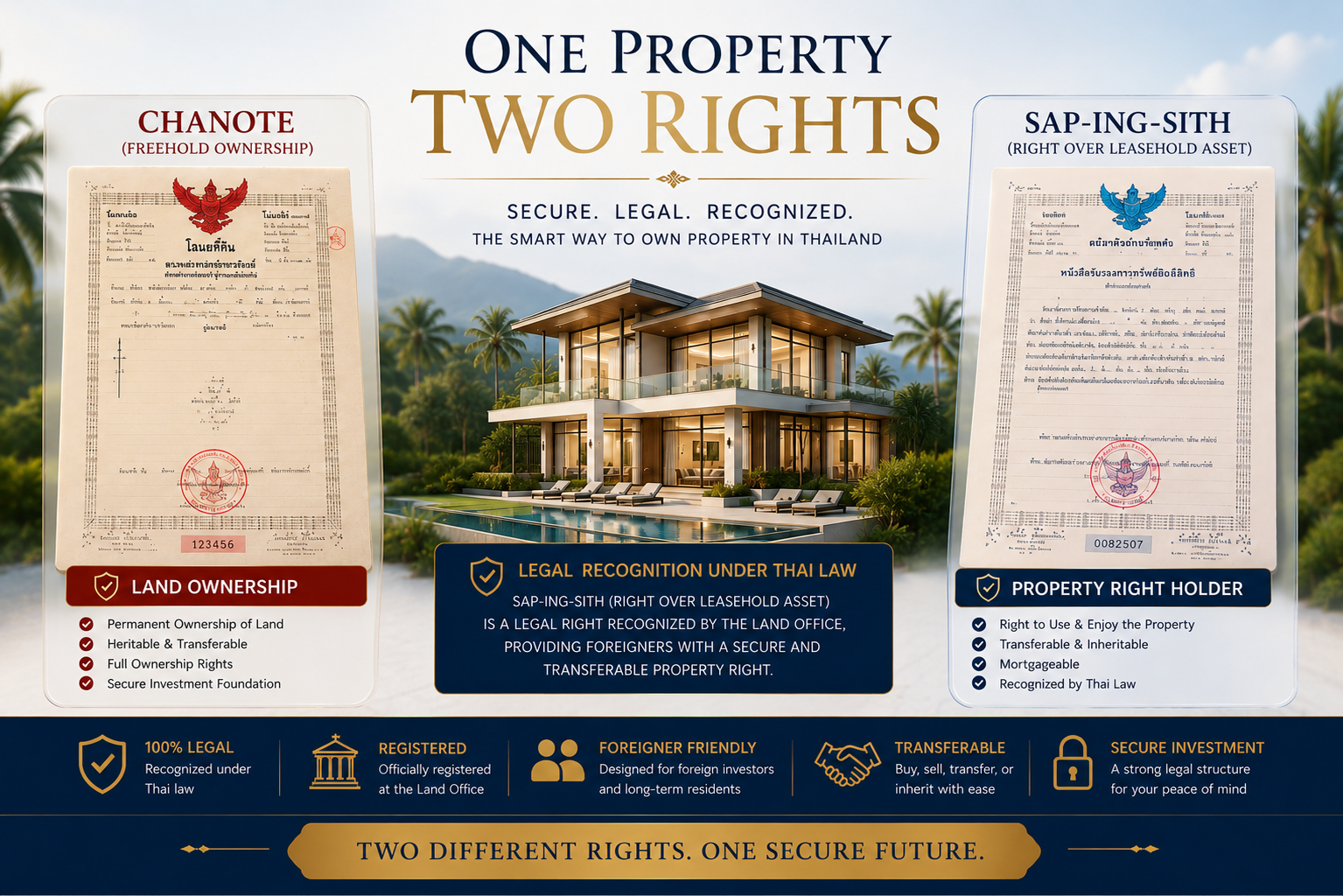
Under current Thai law, Sap-Ing-Sith may only be established over certain categories of immovable property specifically permitted by law.
The most common eligible property types include:
- land that has title deed / Chanote Land Title (Nor Sor 4 Jor)
- land with structure in land that has title deed (Nor Sor 4 Jor)
- strata title condominium unit under the law on condominium (section 3)
In practice, Sap-Ing-Sith structures are particularly common in relation to luxury villas, private residences, retirement properties and long-term foreign investment properties throughout Thailand.
Ownership of Buildings & Construction Rights

One important issue frequently misunderstood by foreign investors is the distinction between ownership of “land” and ownership of “buildings” under Thai law.
Although foreigners are generally prohibited from directly owning land in Thailand, Thai law does not prohibit foreigners from legally owning buildings or structures constructed upon land.
In the context of Sap-Ing-Sith, the holder of the registered right may, subject to applicable laws and approvals, apply for construction permits in their own name and may also legally own the buildings or structures subsequently constructed on the land.
In practice, this is an extremely important feature for foreign investors seeking to develop private villas, retirement residences, vacation homes or long-term residential investment properties in Thailand.
For this reason, proper structuring of both the land rights and the ownership of buildings and improvements remains a critical component of sophisticated property planning involving Sap-Ing-Sith structures.
SAP-ING-SITH vs Traditional Long-Term Leasehold
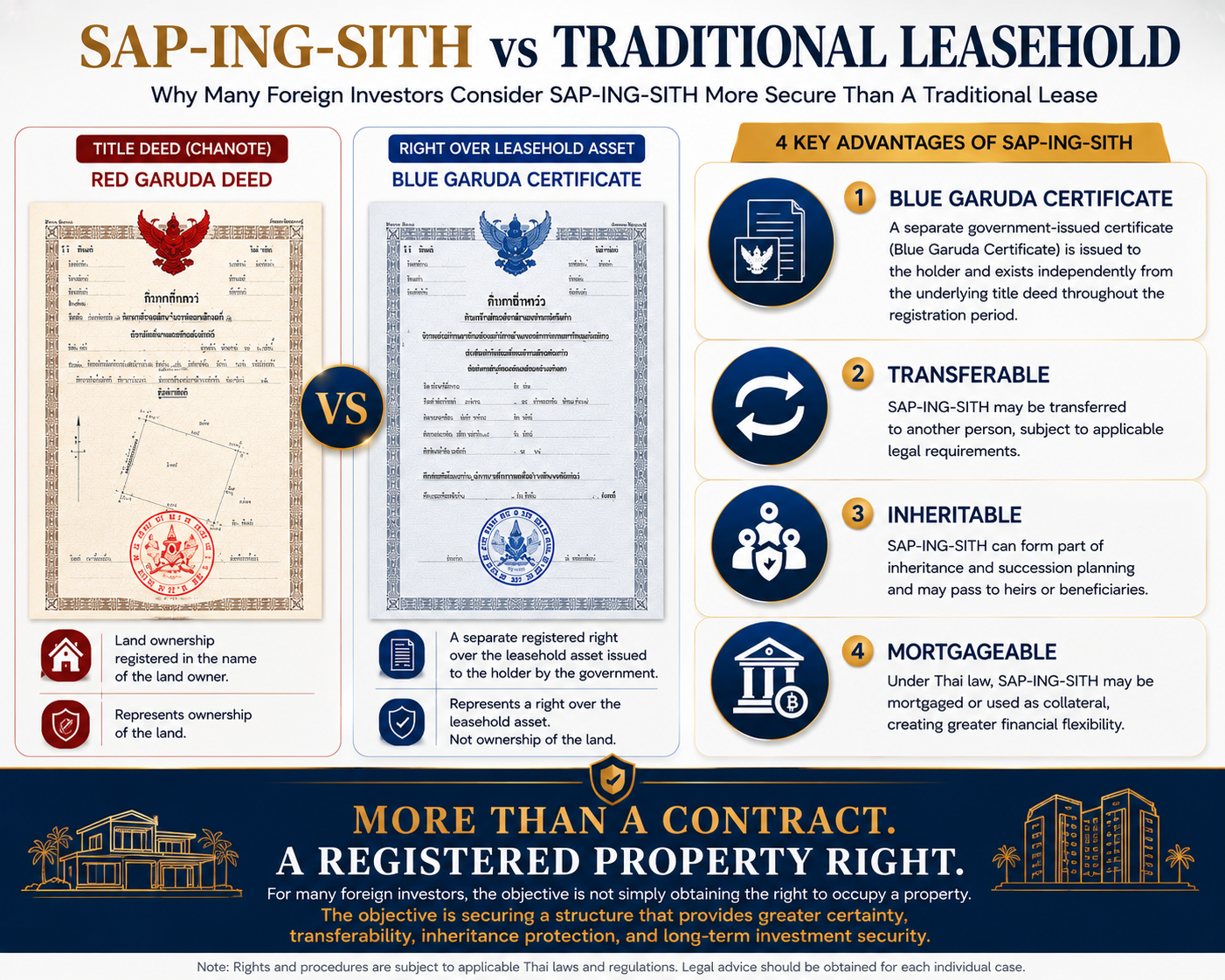
How is SAP-ING-SITH better and more secure than “30-Year Lease Contract”?
1) Upon establishing SAP-ING-SITH, “the certificate of rights over leasehold asset” will be issued to the foreigner, holder. Its function is almost equal to the title deed or strata title (the document of condo ownership—”Aor”Chor 2” in Thai).
2) SAP-ING-SITH is Transferable: Unlike a lease agreement, which is personal to the lessee, a Right Over Leasehold Asset can be transferred to another person.
3) Right Over Leasehold Asset as Collateral: SAP-ING-SITH can be used as collateral for loans or other financial obligations. This provides the holder with greater access to financing options.
4) Right Over Leasehold Asset SAP-ING-SITH as Inheritance: Upon the death of the holder, it can be passed on as part of their inheritance. This ensures the continued enjoyment of the property rights by their successors.
5) A holder of SAP-ING-SITH has right to utilize immovable property. (Section 10) There is no need for the permission of the property owner in official business, ex. applying the building permit, asking for electricity & water meter, doing the plantation, etc.
6) When establishment of SAP-ING-SITH in any immovable property, owner of immovable property cannot establish any proprietary interest in such immovable property except receiving written consent from the holder. (Section 9)
SPEAK WITH A PROPERTY LAWYER
Find out whether SAP-ING-SITH is suitable for your investment goals.
Book Your FREE Initial Consultation Today!!
No Obligation • Professional Legal Assessment • English Speaking Team
OTHER LEGAL STRUCTURES IN THAILAND: SUPERFICIES & USUFRUCT
Besides Leasehold and SAP-ING-SITH, two other important legal structures commonly used in Thailand are:
- The Right of Superficies (สิทธิเหนือพื้นดิน)
Civil and Commercial Code: Sections 1410–1416 CCC - The Right of Usufruct (สิทธิเก็บกิน)
Civil and Commercial Code: Sections 1417–1428 CCC
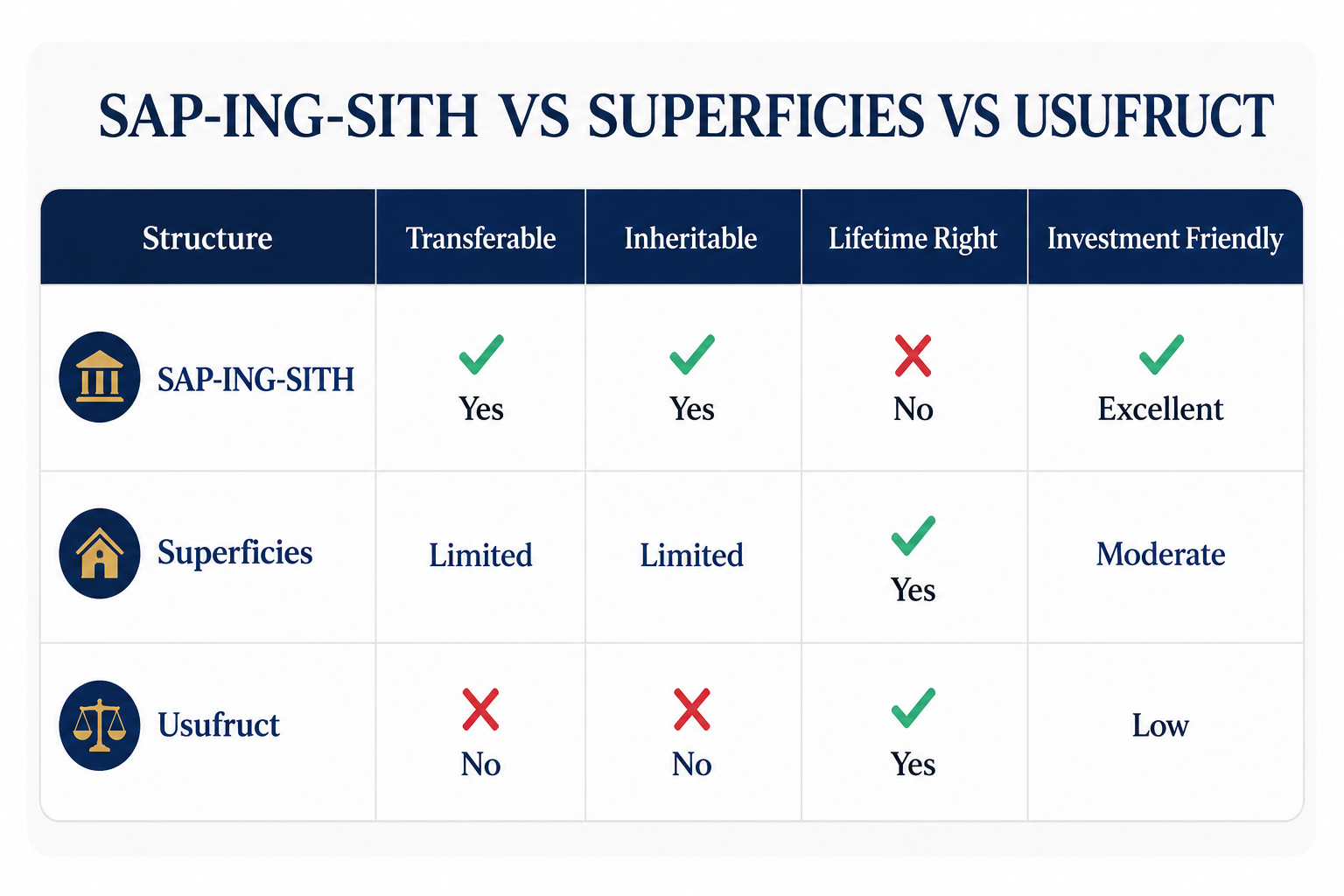
Unlike SAP-ING-SITH, these rights are primarily designed for long-term residential security and family protection, not investment flexibility.
Key Advantage: Lifetime Security
Both Superficies and Usufruct may be registered for:
This means the rights can remain valid for life unless:
- The rights holder passes away, or
- The rights are voluntarily terminated
In many cases, this offers stronger long-term residential security than leasehold and even SAP-ING-SITH
Key Limitation: Personal Rights Only
However, these rights are generally personal rights.
This makes them less suitable for investment or resale.
Best Used For
Superficies and Usufruct are commonly used for:
Important Legal Hint (Updated 2026)
Due to stricter anti-nominee enforcement, Land Offices now increasingly scrutinize Superficies and Usufruct registrations involving foreigners.
In many areas, officials may require proof of genuine relationship between the foreigner and the Thai landowner, such as: Spouse, Parent / Child, Family member
In practice, these structures remain strong for long-term living — but are generally not ideal for investment purposes.
Quick Comparison
- SAP-ING-SITH → Better for investment, transferability, and inheritance planning
- Superficies / Usufruct → Better for lifetime occupancy and family protection
Practical Considerations, Tax Structuring & Long-Term Risks
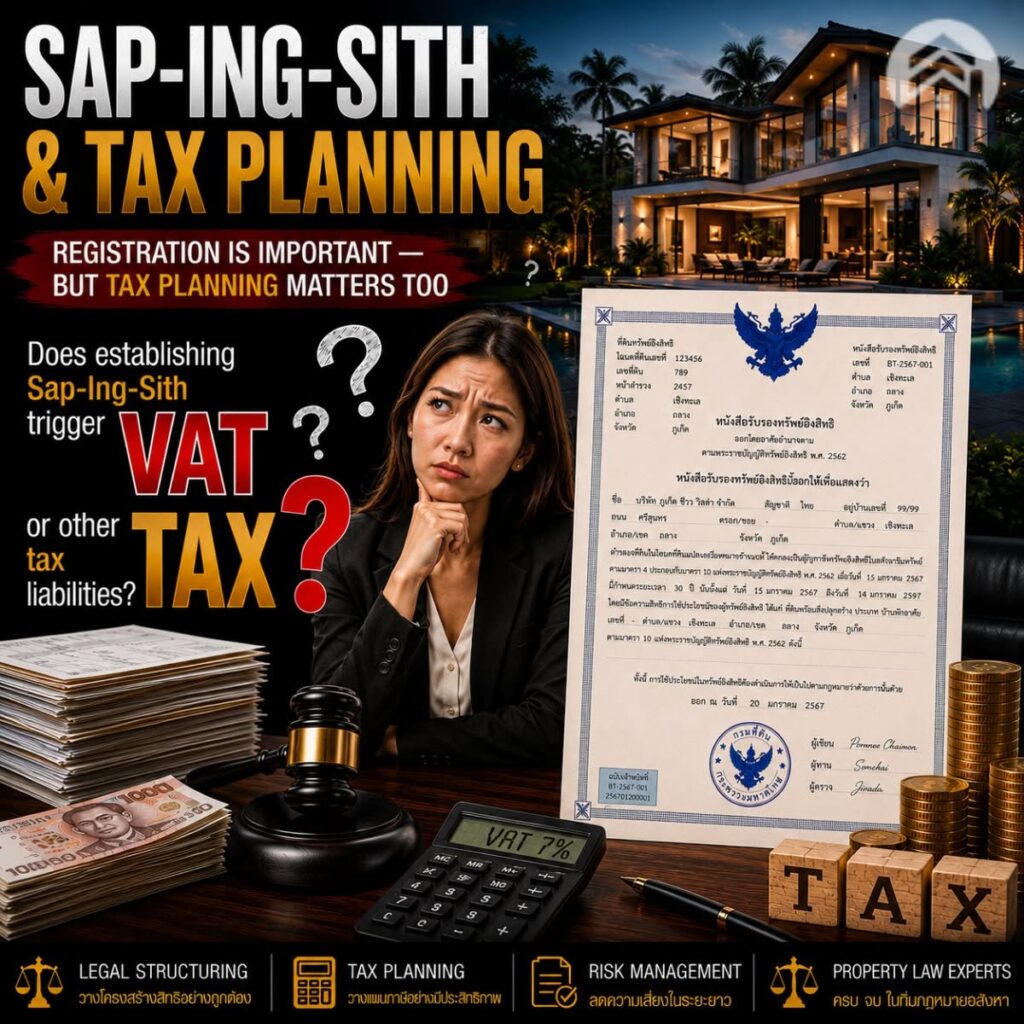
While Sap-Ing-Sith provides a sophisticated legal framework for long-term foreign property investment in Thailand, proper tax planning, ownership structuring, and contractual allocation of responsibilities remain extremely important.
In practice, many investors focus only on whether the Sap-Ing-Sith structure can be successfully registered at the Land Office, without fully considering future tax exposure, annual obligations, long-term service costs, or Revenue Department scrutiny. Some Sap-Ing-Sith establishment agreements merely state that “any future costs or taxes” may be charged to the rights holder, without clearly identifying the type of tax, calculation method, payment timing, or legal basis. This can create serious uncertainty, especially where certain taxes or liabilities legally belong to the registered title holder unless properly allocated by contract in advance.
In some situations, additional liabilities and restructuring costs were later passed on to foreign investors, resulting in unexpected expenses equivalent to approximately 10–20% or more of the property value.
The relevant tax and cost issues may include:
- Land and Building tax, which is generally assessed annually
- Personal Income Tax / Corporate Income Tax, depending on the status of the title holder
- And potential Value-Added Tax (VAT) implications depending on how the transaction, service arrangement, and holding structure are designed. Thailand’s VAT rate is currently 7%, but its application depends heavily on the legal and commercial structure involved.
There is no single fixed model for structuring Sap-Ing-Sith transactions. Different structures may be legally possible, but they can create very different consequences in terms of enforceability, tax exposure, annual costs, long-term obligations, and future regulatory review. The question is not simply whether the structure is “right” or “wrong,” but whether the investor fully understands and accepts the legal, tax, and commercial consequences of that structure.
At House & Condo Lawyer, we do not treat Sap-Ing-Sith registration as a simple document-filing process. We assist clients in structuring the ownership arrangement, tax allocation, annual cost responsibilities, rights and obligations of each party, and long-term risk management from the beginning. Our objective is to ensure that the Sap-Ing-Sith holder understands not only how the right is registered, but also how the structure will operate in practice over the years ahead.
For this reason, sophisticated investors increasingly focus not only on whether a structure can be registered today, but whether the structure has been professionally designed to remain:
- legally sustainable,
- tax-efficient,
- commercially supportable,
- and defensible under future regulatory scrutiny.
Choosing the Underlying Ownership Structure
Who Should Hold the Title Deed?

One of the most important practical questions surrounding Sap-Ing-Sith structures is not only how the right itself should be registered — but who should hold the underlying title deed ownership.
The answer depends heavily on the investment objective, long-term relationship structure, tax planning considerations and the overall legal sustainability of the arrangement.
In practice, several different structures may be used depending on the circumstances involved.
1) Existing Land Owner / Property Owner
In some cases, the original owner or developer continues holding the underlying ownership while establishing Sap-Ing-Sith rights for the foreign investor.
However, long-term contractual obligations should be reviewed carefully, particularly regarding land and building tax, personal income tax exposure, maintenance obligations, renewal obligations, inheritance responsibilities and future re-establishment of rights after expiry.
Improper tax planning or unclear contractual allocation of responsibilities may later create substantial liabilities for both parties.
2) Legitimate Holding Company
Some investors may choose to use a properly structured “Legitimate Holding Company” established under Thai law & 100% Thai Shareholder to hold the underlying ownership and establish Sap-Ing-Sith rights.
Likewise, certain developers may already provide holding structures as part of their investment model. However, Investors should carefully review whether the company has real operational income, shareholders possess genuine financial capability, source of investment funds can be demonstrated and the structure reflects genuine commercial substance.
Long-term tax planning also remains extremely important, particularly regarding corporate income tax, land and building tax, annual service fees, transfer obligations and potential retroactive tax exposure.
3) Thai Spouse
In some situations, investors may choose to structure ownership together with a lawful Thai spouse.
While this may be legally possible, proper source-of-funds documentation, advance legal preparation and long-term contractual planning remain extremely important.
For this reason, House & Condo Lawyer generally recommends preparing a properly drafted Prenuptial Agreement clearly identifying investment funds, ownership intentions, responsibilities and long-term obligations between the parties.
4) Your Existing Thai Company
Some investors may choose to use their own Thai company to hold the underlying ownership structure.
However, investors should ensure that the company conducts genuine business activities in Thailand, possesses real operational income and does not exist solely for property holding purposes.
Proper tax planning, accounting consistency and source-of-funds documentation also remain essential.
Not Sure Which Structure Is Right For You?
Sap-Ing-Sith • Long-Term Lease • Owner • Holding Company • Thai Spouse • Your Company
Book Your FREE Initial Consultation With Our Property Lawyers Today!!
Why We Do NOT Recommend Nominee Structures

House & Condo Lawyer generally does NOT recommend the use of nominee arrangements or artificial shareholder structures created solely to circumvent foreign ownership restrictions under Thai law.
Common nominee warning signs may include:
- unknown shareholders,
- shareholders without sufficient income,
- individuals with no meaningful tax history,
- or shareholders appearing across multiple unrelated companies.
Improper nominee arrangements may create substantial future risks involving criminal exposure, retroactive tax assessment, ownership disputes, inheritance complications and forced asset disposal.
For sophisticated investors, the important issue is not merely whether the structure works today — but whether the structure is professionally designed to remain legally sustainable in the future.
IMPORTANT LEGAL HINTS FOR FOREIGN INVESTORS (UPDATED 2026)
Many foreign investors assume that legal risks arise only when laws change.
In Thailand, that is not always the case.
In reality, many property-related laws have remained largely unchanged for years — and in some cases, decades. The more significant change is often not the law itself, but how government authorities interpret, enforce, and prioritize existing laws.
Historically, certain ownership structures, tax arrangements, and business practices may have operated for many years with little scrutiny. However, when a particular issue becomes widespread, attracts regulatory attention, or begins to undermine the purpose of existing laws, enforcement often becomes significantly stricter.
The law may remain the same.
The enforcement may not.
THE IMPACT OF AI, DATA INTEGRATION & DIGITAL ENFORCEMENT
One of the most significant developments in recent years is not legal reform, but technology.
As a result, information that was once fragmented across multiple government departments is becoming easier to compare, cross-reference, and analyze.
This trend is not limited to Thailand. Governments worldwide are investing heavily in digital infrastructure, data integration, and AI-powered monitoring tools to enhance compliance and enforcement capabilities.
For property investors, this is particularly relevant where information may overlap between:
In practical terms, arrangements that may have attracted little attention in the past can now become far more visible through digital review and data matching.
The issue is often not whether a structure could be established years ago.
The issue is whether it can withstand today’s level of transparency, scrutiny, and regulatory review.
THE KEY QUESTION IS NOT:
“CAN THIS STRUCTURE BE REGISTERED TODAY?”
THE MORE IMPORTANT QUESTION IS:
“WILL THIS STRUCTURE STILL BE DEFENSIBLE 10, 20, OR 30 YEARS FROM NOW?”
For this reason, many foreign investors now place greater emphasis on legal certainty, transparency, succession planning, tax compliance, and professionally structured ownership arrangements when investing in Thailand.
BOOK A LEGAL STRATEGY SESSION
Discuss long-term property protection, succession planning, and ownership structures.
Book Your FREE Initial Consultation Today!!
No Obligation • Professional Legal Assessment • English Speaking Team
Looking for Other Legal Property Ownership Structures in Thailand?
Sap-Ing-Sith is only one of several legal structures available in Thailand. Depending on the investment objective and personal circumstances involved, alternative structures such as Long-Term Leasehold, Superficies, Usufruct, Condominium Ownership, Thai Spouse Structures or Legitimate Holding Company arrangements may also be considered.
However, due to increasing scrutiny concerning nominee arrangements and foreign land holding structures, Land Office officials may refuse registration where the structure appears inconsistent with Thai law or involves suspected nominee ownership.
Because each investor’s situation is different, foreign investors should consult experienced Thailand property lawyers before proceeding with any ownership structure or registration strategy. Improper structuring may result in unnecessary costs, failed registration, retroactive legal exposure or even the loss of the property investment itself.
For more information regarding legal property structures for foreigners in Thailand, please visit:
https://housecondolawyer.com/thailand-property-legal-service-for-foreigners
Frequently Asked Questions (FAQs)
Q1: Can Sap-Ing-Sith be inherited?
Yes. Sap-Ing-Sith may form part of long-term inheritance and succession planning structures.
Q2: Can Sap-Ing-Sith be renewed after 30 years?
Under current Thai law, Sap-Ing-Sith may be registered for a period not exceeding 30 years. Any future renewal or re-establishment would depend upon the legal structure, agreements between the parties and the applicable laws and policies in effect at that time.
Q3: What happens after the 30-year registration period expires?
Upon expiry, the Sap-Ing-Sith right itself terminates in accordance with the law. For this reason, long-term contractual planning, succession planning and future ownership arrangements should be carefully reviewed in advance during the initial structuring stage
Q4: Can Sap-Ing-Sith be sold or transferred?
Yes. Sap-Ing-Sith may generally be transferred, assigned or registered in favor of another person, subject to applicable legal requirements and Land Office procedures.
Q5: Can foreigners obtain financing or mortgage Sap-Ing-Sith rights?
Under Thai law, Sap-Ing-Sith rights may legally be mortgaged or used as collateral. However, financing availability depends upon the lending institution, internal bank policies and the overall investment structure involved.
Q6: Can developers establish Sap-Ing-Sith structures for foreign buyers?
Yes. Certain developers and property owners may establish Sap-Ing-Sith structures as part of long-term foreign investment arrangements. However, the legal structure, tax implications and ownership arrangements should always be reviewed carefully before proceeding.
Q7: What are the tax risks associated with Sap-Ing-Sith structures?
The tax implications depend heavily on the transaction structure, parties involved, ownership arrangements, payment flows and the overall investment design. Professional legal and tax analysis is strongly recommended before registration.
Q8: Sap-Ing-Sith is relatively new and has no Supreme Court precedents yet. Is it riskier than traditional long-term lease registration?
This is a common concern among foreign investors. While Sap-Ing-Sith is still relatively new, as of the date of this publication, we are not aware of any Supreme Court, Appeal Court, or lower court judgments directly involving disputes over Sap-Ing-Sith rights. This should not be viewed as a weakness, but rather reflects the fact that Sap-Ing-Sith is still a relatively new legal structure and has not yet generated significant litigation.
More importantly, many foreign investors misunderstand how legal changes typically occur in Thailand. In practice, Thai law itself rarely changes; what changes more often is the enforcement policy, regulatory interpretation, and administrative practice of government authorities. Importantly, Sap-Ing-Sith is governed under the Sap-Ing-Sith Act B.E. 2562 (2019) — a dedicated Act of Parliament, unlike leasehold under Section 540 CCC, or rights such as Superficies (Sections 1410–1416 CCC) and Usufruct (Sections 1417–1428 CCC). When properly structured and registered, Sap-Ing-Sith remains one of the most secure legal structures currently available for foreign-related property planning in Thailand.
WHY FOREIGN INVESTORS CHOOSE HOUSE & CONDO LAWYER
LEGALLY STRUCTURED.
PROFESSIONALLY REVIEWED.
LONG-TERM INVESTMENT SECURITY.
Protect Your Villa, Land & Property Investment in Thailand Before Problems Arise
Consultation Available For:
- Sap-Ing-Sith Structuring
- Foreign Property Investment
- Villa Investment Structures
- Asset Protection & Succession Planning
- Long-Term Property Holding Structures
SPEAK WITH A SPECIALIZED PROPERTY LAWYER
[ BOOK LEGAL CONSULTATION ]
HOUSE & CONDO LAWYER
Thailand Property Lawyers for Foreign Investors & Real Estate Structuring
PROTECT YOUR THAILAND PROPERTY INVESTMENT WITH CONFIDENCE
Whether you are investing in land, villas, houses, or condominiums, obtaining professional legal advice before choosing an ownership structure can save significant cost, risk, and uncertainty in the future.
BOOK YOUR FREE INITIAL CONSULTATION
FIRST CONSULTATION FREE OF CHARGE
Legal References
This article primarily refers to:
- Rights Over Leasehold Asset Act B.E. 2562 (2019)
- Civil and Commercial Code
- Land Code
- Condominium Act B.E. 2522
- Relevant Ministerial Regulations and Land Department Regulations
Full legislation and official legal references are available upon request during consultation.
MEET OUR LEAD COUNSEL

Lawyer Vivian brings over 15 years of hands-on experience in Thailand’s real estate and property agency sector, making her one of the most trusted legal advisors in this field. She has consistently provided professional legal consultation and representation to both domestic and international clients, with a particular focus on real estate transactions, land ownership, leasehold agreements, and development advisory across Thailand.
With her deep knowledge of Thai property laws and strong background in the practical aspects of the real estate business, Lawyer Vivian bridges the gap between legal requirements and real-world investment — ensuring her clients make well-informed, legally secure decisions.
Education & Qualifications
- LLB. Laws, Chulalongkorn University (Honor)
- M.P.P. Public Policy, University of Sydney, Australia
- B.A. Political Science, Chulalongkorn University (Honor)
- Certificate Secondary School, Belmont, MS.USA
- Certificate RE-CU, Interior Faculty, Chulalongkorn #27
- Attorney License (Thailand)
Areas of Legal Practice and Specialization
- Legal Consultation on real estate and property laws.
- Real Estate Business Contracting Specialist.
- Attorney-at-laws, on trustee and estate settlement.
- Property Transaction and Negotiation.
- Notarial Service Lawyer
- Foreigner Affair & Family Legal Service
- Thailand Visa & Immigration
Experiences
- Foreign Security committee to lead consultant of Deputy Prime Minister.
- Head of Business for corporate Real Estate /Property Agency .
- Property Consultation Australia and Thailand.
- Business Consultation for healthcare business groups.

Lawyer Montira is a highly experienced and respected Thai attorney specializing in corporate governance, compliance, and fraud litigation involving foreign clients in Thailand. With over a decade of legal practice across a range of industries — including real estate, investment, and international business — she is known for her ability to deliver clear, strategic legal advice and handle high-stakes contractual matters with precision.
She has successfully advised numerous companies and investors on regulatory compliance, particularly with the Securities and Exchange Commission (SEC) and the Stock Exchange of Thailand (SET), helping clients navigate legal risks and maintain credibility in the Thai business landscape.
Education & Qualifications
- Master of Laws (LL.M. in International Trade Law) University of Essex, UK
- Bachelor of Laws (LL.B.) Faculty of Law, Thammasat University, Bangkok
- Attorney License (Thailand)
- Notarial Services Attorney License
Areas of Legal Practice and Specialization
- Criminal Offence Procedure from law enforcement level to court’s litigation
- Legal and Government Affairs
- Business Disputes Resolutions
- Listed company secretarial filing
- Real-Estate and Property lawsuits and transaction
Experiences – Head of Legal & Corporate Lawyer & Consultant
- KPN Groups
- Raimon Land Public Company Limited
- TOA Paint (Thailand) Public Company Limited
- Siam Makro Public Company Limited
- Pace Development Corporation Public Company Limited
- Ananda Development Public Company Limited
- PAE (Thailand) Public Company Limited
OUR THAILAND OFFICES
BANGKOK OFFICE

House & Condo Lawyer (Bangkok)
Unit L2-A9, building A (2nd Floor)
Nasa Street Mall (Airport Link Ramkhamhaeng )
No.99 Ramkhamhaeng Rd., Khwaeng Suan Luang,
Suan Luan Bangkok, Thailand 10250
Tel: 080-315-5686
PHUKET OFFICE
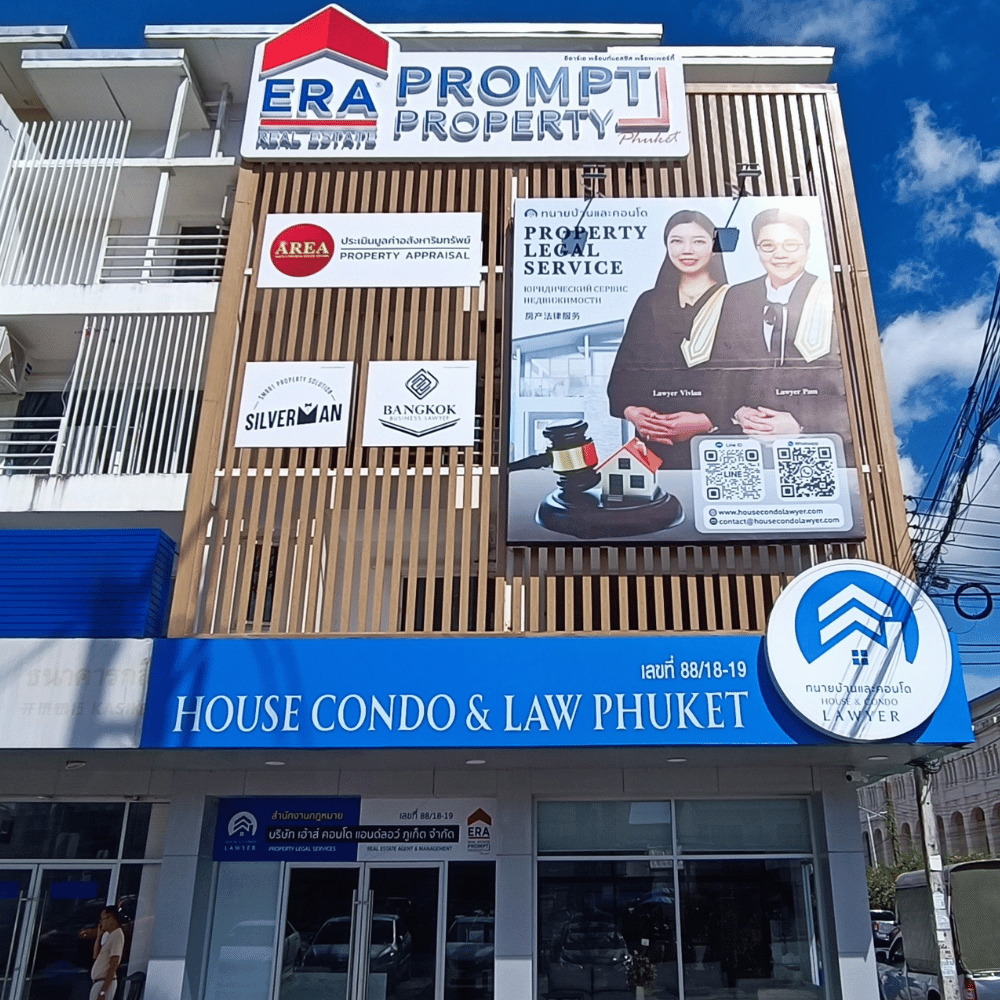
House & Condo Lawyer (Phuket)
88/18 Moo 3 Srisoonthorn Sub district,
Thalang District, Phuket Province 83110
Tel: 098-824-3555 (Phuket & International)
Related Article

Our Services