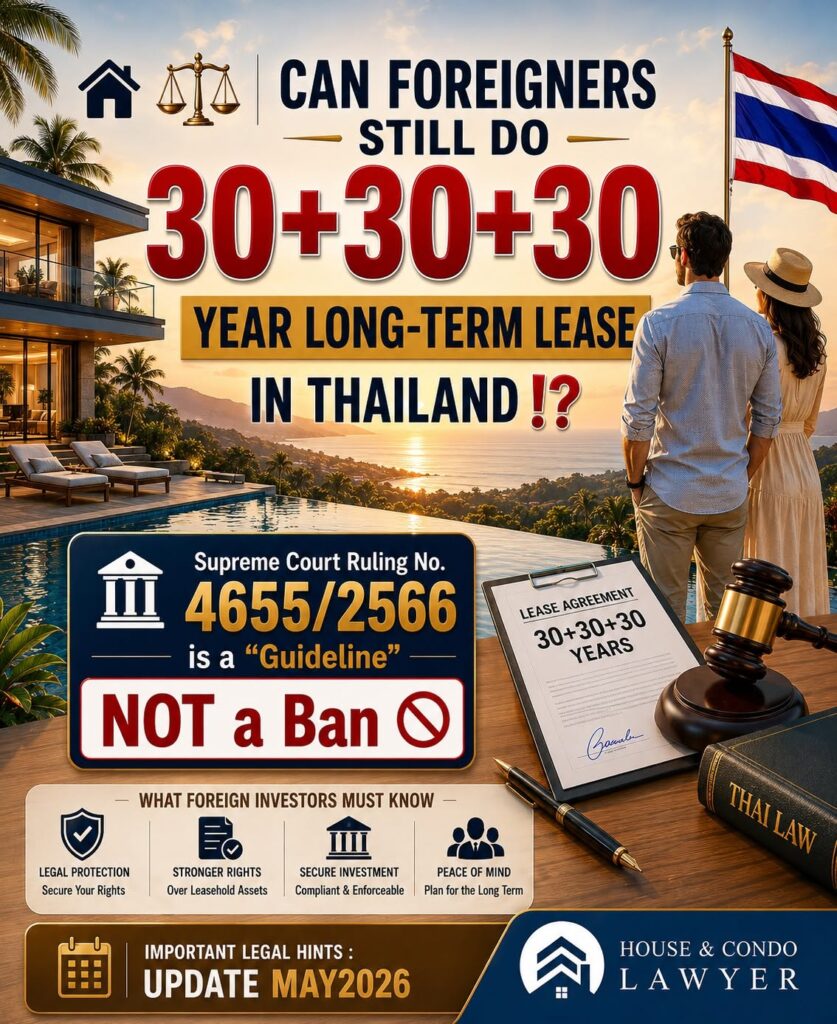

Can Foreigners Still do 30+30+30 Year Long-Term Lease in Thailand ?
.
Supreme Court Judgment No. 4655/2566 is a “Guideline” — NOT a Ban  |
|  Important Legal Hints: UPDATED MAY 2026
.
If you are a foreign investor, retiree, or long-term resident in Thailand, you may recently have heard alarming claims that “30+30+30 year lease structures are now illegal” following Supreme Court Judgment No. 4655/2566.
.
In reality, much of the information circulating online is incomplete, oversimplified, or legally inaccurate. Many lawyers, agents, and even expats are sharing misinformation, creating unnecessary panic.
.
Long-term leases remain legally possible in Thailand — But, you MUST understand the risks, the legal framework, and how to protect your rights with proper legal structuring, tax planning, and compliance with current Land Office practices. Now, they are more important than ever.
.
This article explains what the judgment actually means (and doesn’t mean), why many people misunderstand it, and how foreign investors can better protect their property rights under Thai law
.
.
 # Supreme Court Judgment No. 4655/2566 # (Summary and Analysis)
.
Background of the Case:
.
• Plaintiff: Thai individual who owned land and house under Nor Sor 3 Kor (N.S.3.K) documents No. 1691 and 1692.
• Defendant: Foreign individual who entered into a 30-year lease with a “promise” of two additional 30-year extensions.
• The defendant fully prepaid a total of 2.7 million baht for all 90 years.
.
The lease started on 22 May 1990 and expired in 2020. When the defendant tried to claim renewal, the plaintiff refused and filed a lawsuit to evict the defendant and demand damages.
.
Supreme Court Decision:
.
• The court acknowledged the payment and the parties’ intent to lease for 90 years.
• However, under Section 540 of the Thai Civil and Commercial Code (CCC), leases over 30 years are not allowed per contract.
• Any agreement made in advance to extend the lease beyond 30 years is void.
• The 30+30+30 lease structure—if executed as a single pre-agreed contract—is seen as an attempt to circumvent the law.
.
Result:
.
• The defendant had no legal right to remain after the first 30 years.
• The court ordered eviction and monthly damages of 30,000 THB until the property is vacated.
• Importantly, the court clarified that such lease arrangements must be done within the framework of Thai law—extensions can only be agreed upon after the lease expires.
.
What Did the Supreme Court Actually Say?
.
• Thai Civil and Commercial Code – Section 540
.
“A lease of immovable property shall not be made for a period exceeding thirty years. If it is made for a longer period, such period shall be reduced to thirty years.
However, upon expiration of such period, the lease may be renewed again, provided that the renewed term shall not exceed thirty years from the date of renewal.”
.
Actually, lease registration can be made for a maximum of 30 years per term + 30-Year Renewed Term (Total 60 Years), but due to the attempt to avoid the framework of Thai law, the lease contract was void, and the term was reduced to 30 Years.
.
• “Automatic future renewals” written into the SAME contract may not be enforceable
• Paying upfront for 90 years does NOT automatically secure rights after the first 30 years
.
.
#  Common Misunderstandings #
.
Thailand operates under a Civil Law (Code Law) system, rather than a Common Law system such as that of the United States and some other countries. Thai courts primarily interpret and apply written statutes (the law itself). Accordingly, Supreme Court judgments do not constitute “Binding Law”, but instead serve as persuasive “legal guidelines” for cases involving similar legal issues. As such, court decisions may vary depending on the specific facts, evidence, contractual arrangements, and surrounding circumstances of each individual case.
.
 This case is a legal reminder: “Structure matters.”
.
Important: Supreme Court Ruling No. 4655/2566 is a LEGAL GUIDELINE — not a new law and NOT a prohibition on long-term leasing.
.
 Why Many People Misunderstand
.
• Many foreigners apply “Common Law” concepts directly to Thailand’s Civil Law system.
• Many commentators never read the full Supreme Court judgment No. 4655/2566.
• Social media summaries often oversimplify complex legal issues.
• Some “consultants” or “advisors” discuss Thai law without proper legal qualifications.
• Practicing law in Thailand is a restricted profession under Thai law.
.
.
 # What You Should Do If You Hold a 30+30+30 Year Lease Contract #
.
If you currently hold — or are considering — a long-term lease structure in Thailand, proper legal review is strongly recommended.
.
 Review your lease structure to ensure compliance with Thai law and current Land Office practices.
Avoid contract clauses that attempt to guarantee multiple 30-year renewals within the same agreement, “Same Conditions” as these may be challenged under Section 540 of the Thai Civil & Commercial Code.
Consider restructuring your documents through professionally drafted addenda, supplemental agreements, or renewal mechanisms aligned with current legal interpretations and best practices.
For stronger long-term protection, consider additional registrable real rights such as:
• Right Over Leasehold Asset (Sap-Ing-Sith ทรัพย์อิงสิทธิ)
• Usufruct
• Right of Superficies
• Habitation Right
.
 The legal effects, registration requirements, duration, transferability, inheritance rights, and tax implications of each structure may differ significantly. Professional legal and tax planning is therefore highly recommended before proceeding.
.
For more information : https://housecondolawyer.com/thailand-property-legal…
.
.
 # A Stronger Alternative: “Right Over Leasehold Asset” (Sap-Ing-Sith ทรัพย์อิงสิทธิ) #
.
Thailand now recognizes a legal mechanism called ทรัพย์อิงสิทธิ (Right over Leasehold Asset) under the new Leasehold Right Act.
.
Is registered & Established at the Land Office
Can be created over Chanote (N.S.4) & Condo Title (Or Chor 2)
Gives the holder rights, nearly, similar to ownership
Has its own legal certificate (similar to a sub-title deed)
Does NOT require ongoing landlord approval after registration
Is transferable / inheritable / usable as security
.
Unlike a standard lease: Once registered, the holder can rely on the “Right Over Leasehold Asset” certificate itself — without depending on the original land owner during the registered term.
.
In many cases, this structure provides substantially stronger long-term protection than relying solely on contractual lease renewal promises.
.
 Think of it as: “The closest legal alternative to ownership available for foreigners in Thailand.”
.
 Learn more from Thailand’s leading real estate legal team:
  https://housecondolawyer.com/…/right-over-lease-hold-asset
.
.
 Contact House & Condo Lawyer for legal consultation.
We are a licensed Thai law firm with over 15 years of experience in real estate law. We’ve helped thousands of foreign clients secure their homes and investments in Thailand—legally and safely.
.
Because proper legal structuring today may determine the security of your investment tomorrow
.
 Facebook: House & Condo Lawyer International
 Tel: 098-824-3555 (Phuket & International Line)
 LINE@: housecondolawyer
 Email: [email protected]
.
#ThailandPropertyLaw#LeaseholdThailand#ForeignOwnershipThailand
#90YearLeaseThailand#RightOverLeaseholdAsset#SapIngSith
#NomineeRiskThailand#ThaiPropertyLawyer#ThailandLandLaw
.
———————————————–
.
# UPDATE MAY 2026 — Important Legal Hints!! # Foreign Investors & Buyers MUST Know!!!
.
1) Stricter Anti-Nominee Enforcement : Due to Thailand’s increasing enforcement against “Nominee Structures” for foreign land holding:
.
 Some Land Offices may now:
.
• Closely scrutinize long-term leases involving foreigners
• Request additional supporting documents
• Delay or even reject registrations they consider suspicious
.
2)  AI-Based Tax & Transaction Monitoring | Thailand is increasingly using AI and digital systems to monitor the Lease & Property registrations
.
Therefore: Proper TAX PLANNING is now ESSENTIAL
.
If ownership structures, lease income, or registrations are not properly planned:
 You may face retroactive taxes
Penalties and surcharges
Revenue Department investigations
.
Many property owners are unaware of this risk until many years later.
.
3) Do NOT Establish a Thai Company Solely to Hold Land or a Villa
.
Thailand is now aggressively investigating foreign nominee structures. In practice, if the Office officials detect that a company is effectively controlled by foreigners — especially where Thai shareholders are merely holding shares on behalf of foreigners — registrations will be rejected entirely.
.
Many foreigners lose substantial amounts of money setting up companies that later cannot complete registration or become subject to investigation.
.
Improper nominee arrangements may expose parties to:
• Criminal liability
• Property forced sale
• Tax investigations and retroactive taxes
• VISA revocation
• Deportation and immigration blacklisting
• Significant fines and imprisonment in certain cases
.
 If anyone — whether an agent, consultant, “legal advisor,” or even a lawyer — recommends setting up a company purely to acquire land for a foreigner, especially by arranging Thai shareholders or proxy holders on your behalf:
“WALK AWAY IMMEDIATELY!!!!”
This is a major legal red flag and should be treated with extreme caution.
.
And for those already using nominee structures or Thai companies purely to hold land or villas: Please understand clearly — enforcement is no longer theoretical. Investigation and legal action are increasingly inevitable; the only uncertainty is “timing”.
.
Do NOT assume that because your structure has existed for many years, it is “safe” or will escape scrutiny.
.
If your structure is improper, urgently seek professional legal advice and restructure it correctly BEFORE problems arise.
.
———————————————–
.
 # Full Summary of Supreme Court Judgment No. 4655/2566 #
# Parties:
Plaintiff: Mrs. S.
Defendant: Mr. R.
Legal Issue: Invalidity of lease term (Void Agreement) under Sections 150 and 540 of the Civil and Commercial Code (CCC)
.
# Case Summary:
.
The plaintiff sued to evict the defendant and remove all structures from land covered by Nor Sor 3 Kor documents No. 1691 and 1692. The plaintiff also claimed for monthly damages. The defendant counterclaimed, arguing that the lease should be registered for a new 30-year term from 22 May 2020, based on previous agreements and advance payment.
The lower court ruled in favor of the defendant, but the Appeal Court reversed the decision, ordering eviction and monthly damages of 50,000 THB. The Supreme Court later reduced this to 30,000 THB per month and upheld the eviction.
.
# Key Legal Reasoning:
.
• Although the defendant had paid rent for the full 90 years (totaling 2.7 million baht), the advance promise to extend the lease twice (30+30 years) was deemed an attempt to circumvent Thai law.
• Section 540 of the CCC limits lease terms to 30 years per contract. Any extensions must be agreed after the initial lease ends.
• The “promise” to renew within the original lease was therefore void.
• Once the original lease expired, the defendant had no further right to remain and was liable for damages.
.
# Conclusion:
.
Only the initial 30-year lease was valid. Extensions beyond that, if pre-agreed in the same contract, are unenforceable under Thai law.
This ruling serves as a guideline for interpreting lease contracts but does not constitute binding law in all future cases.