

Family Law for foreigner & Child Custody Attorneys in Thailand | House & Condo Lawyer
Trusted family law and child custody attorneys in Thailand assisting Thai and international clients with prenuptial agreements, marriage registration, marital assets,divorce, custody, child support, adoption, wills and inheritance matters.

Family Law & Child Custody Attorneys in Thailand
Protecting Your Rights. Securing Your Child’s Future.
When a marriage ends or a family dispute arises, your priorities may include protecting your child, preserving your financial security, and understanding your legal rights under Thai law.
House & Condo Lawyers provides compassionate, strategic, and practical legal representation in Thai family law matters for Thai nationals, foreign residents, and international families.
Whether you are planning a marriage, considering separation, facing divorce proceedings, dealing with a child custody dispute, seeking child or spousal support, or trying to resolve disagreements over marital property, our legal team helps you understand your legal position and navigate each stage of the process with greater clarity and confidence.
Not sure where to start? Complete our Initial Family Case Screening Form
and our legal team will review your matter before your consultation.
WE’RE READY TO SUPPORT YOUR FAMILY LIFE IN THAILAND
Contact us for a confidential consultation.
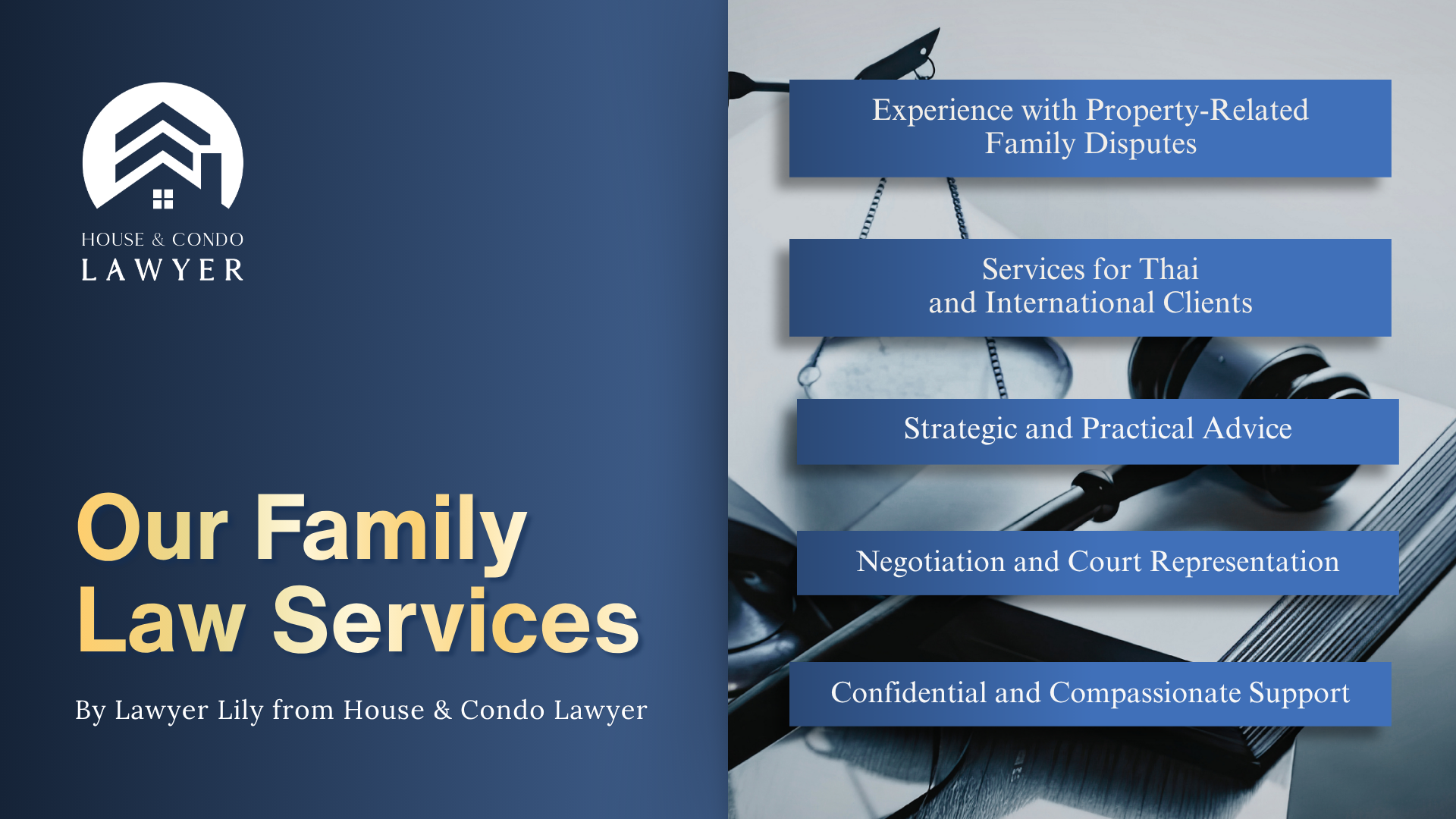
Our Family Law Services
Why Choose House & Condo Lawyers?
Divorce cases frequently involve significant property issues, including houses, condominium units, land arrangements, mortgages, company structures, leases, and assets registered or held in different names.
Our experience in property-related legal matters allows us to consider both the family law and property law consequences of a dispute rather than treating the divorce and the assets as completely separate issues.
This can be particularly important where property ownership, beneficial interests, mortgages, company shareholding, rental income, contractual arrangements, or the source of funds used to acquire an asset becomes disputed between the spouses.
Services for Thai and International Clients
We assist Thai nationals, foreign residents, overseas clients, and multicultural families.
International clients often face additional challenges involving language, unfamiliar legal procedures, foreign documentation, overseas assets, or the need to coordinate legal issues in more than one jurisdiction. We therefore place particular emphasis on clear communication throughout the legal process.
Strategic and Practical Advice
A family dispute should not be approached solely as a legal argument. Before recommending a strategy, we evaluate the client’s legal position, the available evidence, likely costs, procedural requirements, practical settlement possibilities, and the consequences that different legal options may have for the family, children, property, and finances.
Our objective is to help the client make informed decisions rather than commencing unnecessary proceedings without first understanding the available options.
Negotiation and Court Representation
Where a workable settlement can protect the client’s interests, negotiation may provide a more efficient and predictable solution than prolonged litigation.
Where settlement is inappropriate, the other party refuses to cooperate, or an acceptable agreement cannot be achieved, we provide court representation and pursue the legal remedies necessary to protect the client’s rights.
Confidential and Compassionate Support
Family law disputes often involve deeply sensitive personal, financial, and family information.
We handle each matter professionally, discreetly, and with respect for everyone involved while remaining focused on protecting our client’s legal position and achieving a practical resolution.
Every family law case is different.
Tell us about your situation by completing our Initial Family Case Screening Form.
This helps us understand your case before we contact you.
WE’RE READY TO SUPPORT YOUR FAMILY LIFE IN THAILAND
Contact us for a confidential consultation.
Comprehensive Family Law Services in Thailand
We provide legal advice, document preparation, negotiation, and court representation across a broad range of Thai family law matters, led by a team of highly skilled attorneys with extensive experience in assisting foreign nationals in Thailand.
1. Prenuptial Agreements
A properly prepared prenuptial agreement can help a couple clearly establish property ownership, financial responsibilities, and the treatment of certain assets and liabilities before marriage.
We assist clients with drafting prenuptial agreements under Thai law and identifying which assets should remain personal property, commonly known as Sin Suan Tua. This may include the protection of businesses, investments, and other assets acquired before marriage, as well as provisions dealing with liabilities incurred prior to the marriage.
For international couples, we can also prepare bilingual agreements and coordinate the documentation required so that the prenuptial agreement can be registered together with the marriage.
Under Thai law, a prenuptial agreement should be properly prepared and registered at the time of marriage registration. If the agreement is prepared incorrectly or is not registered in accordance with the applicable legal requirements, it may later become difficult or impossible to enforce.
2. Marriage Registration
We assist Thai nationals, foreign residents, and cross-border couples who wish to complete a legally valid marriage registration in Thailand.
The process may involve reviewing the legal requirements applicable to both parties, preparing and translating supporting documents, coordinating embassy affirmations or marital-status documentation, arranging legalization where required, and assisting with registration before a Thai District Office, or Amphur.
Where a marriage has already been registered outside Thailand, we can also advise on issues concerning recognition of the overseas marriage in Thailand.
For international couples, documentation and procedural requirements may differ depending on the nationality of each party and the requirements imposed by the relevant embassy or governmental authority. Reviewing these requirements before attempting registration can help prevent unnecessary delays or problems with documents.
3. Divorce Proceedings
House & Condo Lawyers represents clients in both administrative divorces and court-based divorce proceedings.
Uncontested Divorce
Where both spouses agree to divorce and the marriage was registered in Thailand, it may be possible to complete an administrative divorce at a District Office without commencing contested court proceedings.
An uncontested divorce nevertheless requires careful attention to the terms agreed between the spouses. We can prepare a divorce settlement addressing child custody and visitation arrangements, child and spousal support, marital property and debt division, and the transfer or treatment of houses, condominium units, interests in land, vehicles, company shares, and other assets.
For international families, bilingual divorce documentation can also be prepared where the settlement or divorce record may later need to be used outside Thailand.
Contested Divorce
Where one spouse refuses to divorce, or where the parties cannot agree on important matters such as children, financial support, property, or liabilities, court proceedings may become necessary.
In these circumstances, we assess whether legally recognized grounds for divorce exist, prepare and file the appropriate divorce claim, organize documentary and witness evidence, negotiate where a settlement remains possible, seek interim protective measures where appropriate, and represent the client throughout the court proceedings.
The appropriate strategy will depend on the circumstances of the marriage, the available evidence, the legal grounds relied upon, and the issues that must ultimately be determined by the court.
4. Child Custody and Parental Authority
Child custody disputes are often among the most sensitive and difficult aspects of separation or divorce.
Under Thai law, the legal issue commonly involves parental authority, including the authority to make important decisions concerning a child’s residence, education, healthcare, property, and general welfare.
Depending on the circumstances, we assist parents in negotiating sole or joint parental authority, preparing custody provisions for divorce agreements, filing court petitions to determine parental authority, establishing legal paternity, and arranging appropriate visitation and contact with the child.
International families may also encounter questions concerning relocation or custody across national borders. Existing custody arrangements may need to be modified when circumstances change, and in serious situations involving abuse, neglect, addiction, or other harmful conduct, an application for revocation of parental authority may need to be considered.
Our approach focuses on protecting our client’s parental rights while keeping the child’s welfare at the centre of the legal strategy.
5. Child Support and Spousal Maintenance
Both parents remain responsible for supporting their child regardless of which parent provides the child’s day-to-day care.
Child support arrangements may need to address much more than a single monthly payment. Depending on the family’s circumstances, appropriate support may include school fees and other educational expenses, medical and healthcare costs, accommodation, and the child’s ordinary daily living expenses.
We represent both custodial and non-custodial parents in determining appropriate child support, negotiating monthly maintenance arrangements, seeking court orders, enforcing unpaid support, and requesting modification of an existing support arrangement following a material change in circumstances.
Where permitted by law and supported by the circumstances of the case, we can also advise on claims involving spousal maintenance.
When determining support, the court may consider factors including the child’s needs, education, previous standard of living, healthcare requirements, and the financial capacity of each parent.
6. Marital Assets and Liability Division
Financial disputes following the breakdown of a marriage can involve considerably more than dividing money held in a bank account.
Our legal team assists clients with identifying, tracing, valuing, negotiating, and dividing property that may include houses, condominium units, land or contractual interests relating to land, bank accounts, investments, business interests, company shares, vehicles, valuable personal property, rental income, and other income-producing assets.
Financial disputes may also concern mortgages, personal loans, matrimonial debts, or assets that one spouse alleges were transferred, concealed, or placed in another person’s name before divorce proceedings began.
An important part of the analysis is distinguishing marital property, commonly known as Sin Somros, from personal property, or Sin Suan Tua. We examine how and when the property was acquired, its ownership history, the source of funds used, relevant financial records, and other supporting evidence before developing an appropriate legal and settlement strategy.
7. Adoption, Guardianship, and Property Owned by Minors
Family law issues do not necessarily end with divorce or custody proceedings. Families may also require legal assistance with adoption, paternity, guardianship, or the management of assets belonging to children.
We advise on domestic adoption, inter-country adoption, and step-parent adoption, as well as legal paternity and legitimation matters. Where a child does not have an appropriate person legally able to act on his or her behalf, court proceedings may be required for the appointment of a legal guardian.
We also assist with applications concerning the management or disposal of property owned by a minor.
Even where a parent exercises parental authority, the parent cannot freely complete every significant transaction involving property registered in the child’s name. Depending on the transaction, prior court approval may be required before property belonging to a minor can be sold, mortgaged, exchanged, or made subject to certain long-term arrangements.
8. Wills and Estate Administration for Families
Family law and succession planning are often closely connected, particularly where a family owns property in Thailand, has minor children, or includes family members of different nationalities.
We assist clients with Thai wills, bilingual wills, and cross-border estate planning coordination. We also advise on the appointment of an executor or estate administrator, court petitions concerning estates situated in Thailand, the distribution of Thai-based assets, and estate matters involving foreign heirs or deceased foreign nationals.
For parents with minor children, succession planning can also address important concerns relating to guardianship, management of property, and inheritance.
A properly considered estate plan can reduce uncertainty about who will manage property, how Thai assets will be distributed, and how the interests of children and other family members will be protected after death.
Need Family Law Advice? Our experienced attorneys are ready to help with divorce,
child custody, support, and cross-border family matters.
WE’RE READY TO SUPPORT YOUR FAMILY LIFE IN THAILAND
Contact us for a confidential consultation.

Child Custody Disputes
Parents do not always agree on where their child should live, who should make important decisions, how often each parent should have contact with the child, or whether parental authority should be exercised jointly or by only one parent.
Where possible, we help parents negotiate workable parenting arrangements that provide greater certainty and stability for the child. Where an agreement cannot be reached, court proceedings may be necessary to determine parental authority and related issues.
Visitation Being Denied
Following separation or divorce, one parent may be prevented from seeing, visiting, or communicating with the child. Informal arrangements may also break down as relations between the parents deteriorate.
In these circumstances, we can review any existing agreement or court order and advise on the appropriate course of action, whether through negotiation, enforcement proceedings, or an application seeking appropriate visitation and contact arrangements.
Unpaid Child or Spousal Support
n some families, the parent providing day-to-day care for the child may find themselves paying virtually all household, educational, medical, and living expenses while the other parent refuses or fails to make an appropriate financial contribution.
We assist clients with maintenance claims, negotiation of support arrangements, applications for court orders, and enforcement proceedings where child or spousal support remains unpaid.
Marital Property and Debt Disputes
A divorce may give rise to disputes over whether particular property is personal or marital property, how an asset should be valued, whether an asset has been transferred or concealed, and which spouse should remain responsible for particular debts.
Our lawyers examine ownership history and financial documentation, trace relevant assets where possible, and pursue a legally appropriate division based on the circumstances and supporting evidence.
Adultery and Compensation Claims
In certain circumstances, adultery may be relevant to a contested divorce and may also be connected with a related claim for compensation.
Whether such a claim can succeed depends on the parties’ legal marital status, the nature of the conduct involved, the timing of the proceedings, and the quality and availability of the evidence. Each case should therefore be assessed on its individual facts before proceedings are commenced.
Property Owned by a Minor
Parents may wish to sell, mortgage, lease, or otherwise manage property that has been registered in the name of their child.
Although a parent may exercise parental authority, Thai law does not necessarily allow the parent to complete every important property transaction on the child’s behalf without further authorization. Prior court permission may therefore be required before the proposed transaction can lawfully proceed
Adoption and Guardianship
omestic and international adoption matters may require coordination with several government authorities and can involve extensive documentation, home-country requirements, administrative procedures, and court proceedings.
Similarly, guardianship may become necessary where there is no parent or other person legally able to exercise the required authority on behalf of the child.
We help clients identify the applicable procedure and complete the necessary legal process according to the circumstances of the family and the child.
Facing a Family Dispute in Thailand? Do not rely solely on verbal promises or informal arrangements when your child, property, or financial security is at risk.

Resolving Custody Disputes in the Child’s Best Interests
here is no automatic rule that every child must remain with the mother or, alternatively, with the father following divorce. The appropriate arrangement depends on the legal status of the parents, the terms of any divorce agreement, the existing allocation of parental authority, and ultimately the child’s best interests.
When parents cannot agree and the matter must be determined by the court, the court may examine the child’s age and individual needs, physical and emotional welfare, relationship with each parent, and the stability of each proposed home environment. The court may also consider each parent’s ability to provide appropriate care, the child’s education and healthcare arrangements, and whether there is any history of abuse, neglect, addiction, or other harmful behaviour.
Where siblings are involved, the practical consequences of separating them may also be relevant, together with any other circumstances capable of affecting the child’s welfare, safety, stability, or long-term development.
Financial strength alone does not necessarily determine custody. The court’s assessment is generally broader and focuses on the overall circumstances affecting the child’s safety, stability, care, and long-term welfare.
Need Family Law Advice? Our experienced attorneys are ready to help with divorce,
child custody, support, and cross-border family matters.
WE’RE READY TO SUPPORT YOUR FAMILY LIFE IN THAILAND
Contact us for a confidential consultation.

Common Child Custody Challenges
Parents Cannot Reach an Agreement
Both parents may seek sole parental authority, or they may disagree over where the child should live and how important decisions should be made.
A carefully negotiated parenting agreement may resolve these issues without prolonged litigation. Where meaningful negotiation fails, however, a court application may be required to determine parental authority and the appropriate arrangements for the child.
One Parent Carries the Entire Financial Burden
The parent caring for the child may be responsible for virtually all expenses relating to accommodation, education, healthcare, food, transportation, and ordinary daily needs.
Where the other parent does not make an appropriate contribution, legal advice may be required regarding negotiation, a child support claim, or an application for a court order.
A Parent Is Prevented from Seeing the Child
Informal visitation arrangements can quickly break down following conflict between parents. A parent may then find that promised visits are repeatedly cancelled or communication with the child is restricted or completely prevented.
A clear written agreement or court order can establish predictable contact arrangements, clarify the rights and responsibilities of each parent, and reduce the likelihood of repeated disputes.
A Parent Needs to Manage the Child’s Property
Even a parent who legally exercises parental authority may require prior court approval before carrying out certain important transactions concerning property owned by the child.
Legal advice should therefore be obtained before entering into any transaction that may fall within the restrictions applicable to a minor’s property.
The Child Has No Suitable Legal Guardian
Guardianship proceedings may be required where both parents have died, lack legal capacity, have had their parental authority revoked, or are otherwise unable to provide legally appropriate care for the child.
The appropriate court application will depend on the child’s circumstances and the legal status of the person proposed to act as guardian.
A Family Wishes to Adopt
Adoption creates a legal parent-child relationship and therefore requires completion of the formal legal procedures applicable to the circumstances.
Simply caring for or raising a child in practice does not automatically create the legal status of a parent. Domestic, step-parent, and international adoption cases should therefore be handled through the appropriate legal and administrative process.
Legal Framework for Child Custody in Thailand
Determination of Parental Authority
When divorcing parents cannot reach an agreement regarding parental authority, the issue may need to be determined by a Thai court.
Rather than deciding the matter solely on the basis of a parent’s gender or financial income, the court will consider the welfare of the child together with the circumstances of each parent and the family as a whole.
Child Support Obligations
Divorce does not terminate either parent’s responsibility to financially support the child.
The amount, structure, and method of payment may be agreed between the parents or determined by the court. Relevant considerations may include the child’s reasonable needs and the financial circumstances and capacity of each parent.
Court Approval for Transactions Involving a Minor’s Property
Thai law requires prior court authorization for certain transactions involving property belonging to a minor.
Entering into a restricted transaction without obtaining the required authorization may result in serious legal difficulties and may also create problems when attempting to register the transaction with the relevant authority.
Modification or Revocation of Parental Authority
Custody and parental authority arrangements are not necessarily permanent in every circumstance.
Where there has been a material change in the family’s circumstances, or where a parent’s conduct places the child at risk, an existing arrangement may need to be reconsidered. Serious neglect, abuse, substance dependency, misuse of the child’s property, or persistent conduct contrary to the child’s welfare may justify further court intervention, including an application concerning modification or revocation of parental authority.
Take Action Before the Dispute Escalates
Child custody and family cases are highly fact-specific, and evidence that initially appears unimportant may later become central to negotiations or court proceedings.
Messages between the parents, school records, financial evidence, medical documents, photographs, travel records, and witness evidence may all become relevant depending on the issues in dispute.
Obtaining legal advice at an early stage can therefore be important, particularly before signing a settlement agreement, removing a child from Thailand, transferring property, or commencing court proceedings.
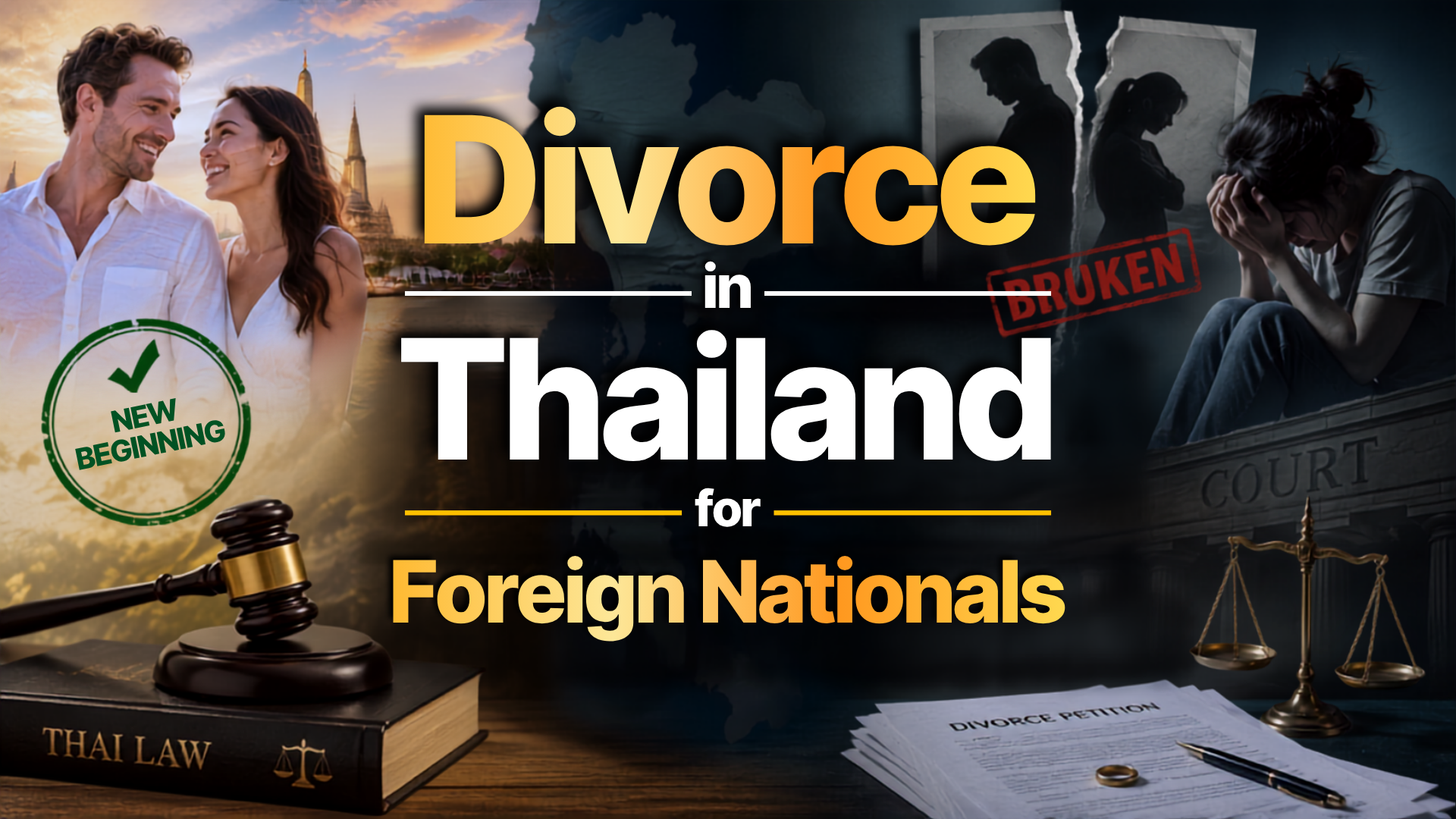
International Divorce and Cross-Border Family Matters
Family law becomes considerably more complex when a marriage, divorce, child, or property dispute involves more than one country.
Questions may arise over whether a Thai court has jurisdiction, whether a marriage registered overseas can be dealt with in Thailand, how proceedings can be served on a spouse living abroad, and whether a Thai divorce judgment or custody order will be recognized in another country.
The nationality of the spouses and the law applicable to the marriage may also become relevant. Depending on the circumstances of the case, foreign law may affect or prevent the court from granting the requested divorce.
For this reason, cross-border family cases should be reviewed before proceedings are filed so that the appropriate jurisdiction, procedure, and supporting documentation can be identified.
International Divorce Issues We Handle
Our international family law practice includes Thai–foreign marriages as well as cases in which both spouses are foreign nationals residing in Thailand. We also assist where one spouse lives outside Thailand or where the marriage itself was registered overseas.
Depending on the matter, our work may involve recognition of foreign divorce judgments, international service of court proceedings, child custody disputes across national borders, overseas child support enforcement, and questions concerning Thai property owned by international couples.
Cross-border divorce may also involve foreign business interests and investments, requiring the family law issues to be considered alongside the ownership and financial structure of those assets.
Where documentation must be used both in Thailand and overseas, we can prepare bilingual divorce settlement agreements and advise on divorce documents that may be required for use before foreign authorities.
International Marriage, Thai Divorce, or Cross-Border Custody Problem? Cross-border cases should be assessed before filing. The correct procedure may depend on both Thai law and the national law of one or both spouses.

Frequently Asked Questions
Can a Foreigner File for Divorce in Thailand?
Potentially, yes. Whether a divorce can proceed in Thailand and which procedure should be used depends on several factors, including where the marriage was registered, the nationality of each spouse, whether both spouses agree to the divorce, and whether the legal requirements for an administrative divorce or court divorce in Thailand are satisfied.
For international marriages, jurisdiction and the effect of foreign law may also need to be considered before proceedings are commenced.
Can We Divorce at a District Office?
An administrative divorce generally requires mutual consent and a marriage that is capable of being dissolved through the Thai registration process.
Both parties must normally cooperate with the registration. Where one spouse refuses to participate, or where the parties cannot agree on the divorce or important related matters, court proceedings may be required instead.
Does the Mother Automatically Receive Custody?
Not in every case.
Parental authority depends on the parents’ marital and legal status, the terms of any registered divorce agreement, and any applicable court order.
Where the court is required to determine the issue, the welfare and best interests of the child are central considerations rather than an automatic assumption that parental authority must belong to the mother.
Can a Father Obtain Custody in Thailand?
Yes. A father may seek parental authority or custody where he has the necessary legal status and the requested arrangement is consistent with the child’s welfare.
Where the biological parents were not married, however, an unmarried father may first need to complete the appropriate legal legitimation process before exercising or seeking certain parental rights.
How Is Child Support Calculated?
Thai law does not impose one fixed child support amount that applies to every family.
The appropriate amount will depend on the circumstances of the child and the parents. Relevant considerations may include the child’s reasonable living needs, education, healthcare, previous standard of living, and the financial circumstances and capacity of each parent.
Can I Sell Property Registered in My Child’s Name?
Not freely in every case.
Certain transactions involving property owned by a minor require prior permission from the court. This can be relevant to sales, mortgages, exchanges, leases, or other significant transactions involving the child’s property.
Legal advice should therefore be obtained before signing a sale agreement, accepting a deposit, or submitting documents to the Land Office.
Can a Thai Court Divide Overseas Assets?
The answer depends on several factors, including the nature of the asset, where it is located, the Thai court’s jurisdiction, the available evidence, and whether any Thai judgment concerning the asset can be recognized or enforced in the country in which the property is situated.
International asset disputes should therefore be considered on a jurisdiction-by-jurisdiction basis.
Will My Thai Divorce Be Recognized Overseas?
Recognition of a Thai divorce depends on the law of the country where the divorce record or judgment will subsequently be used. Depending on that country’s requirements, further registration, certification, legalization, authentication, or court recognition may be necessary before the Thai divorce has the intended legal effect overseas.
Meet Our Family Law Attorney

Thitiwaraporn Boonon (Lawyer Lily)
Thitiwaraporn Boonon, also known as Lawyer Lily, provides legal advice and representation in family law matters for both Thai and international clients. Her practice includes divorce, child custody, child support, marital property division, prenuptial agreements, wills, and cross-border family disputes.
With a strong background in real estate law, Lawyer Lily is particularly well positioned to advise on family cases involving houses, condominium units, land, and other valuable assets.
Family disputes involving property frequently require more than a general understanding of divorce law. Questions may arise concerning how an asset was acquired, whose name appears on the title, whether the property is marital or personal property, whether a mortgage or contractual obligation exists, and how the asset can legally be transferred or divided as part of a settlement or court proceeding.
By considering these issues together, Lawyer Lily provides strategic legal guidance designed to help clients protect both their legal rights and their financial interests throughout the family law process.
Your family, child, property, and financial future deserve careful legal protection.
Whether you are planning a marriage, negotiating a separation, pursuing a divorce, resolving a custody dispute, claiming financial support, dealing with marital assets, or managing an international family matter, House & Condo Lawyers can assess your situation and explain the legal options available under the circumstances.
Need Family Law Advice? Our experienced attorneys are ready to help with divorce,
child custody, support, and cross-border family matters.
WE’RE READY TO SUPPORT YOUR FAMILY LIFE IN THAILAND
Contact us for a confidential consultation.
Family Law Initial Screening Form
Tell us about your case. Our legal team will review your information before scheduling a consultation.